-
About
 Fidelity & Excellence
Thomas Aquinas College is unique among American colleges and universities, offering a faithfully Catholic education comprised entirely of the Great Books and classroom discussions.
-
A Liberating Education
 Truth Matters
Truth, and nothing less, sets men free; and because truth is both natural and supernatural, the College’s curriculum aims at both natural and divine wisdom.
-
A Catholic Life
 Under the Light of Faith
The intellectual tradition and moral teachings of the Catholic Church infuse the whole life of Thomas Aquinas College, illuminating the curriculum and the community alike.
-
Admission & Aid
 Is TAC Right for You?
Do you enjoy grappling with complex questions? Are you willing to engage in discussions about difficult concepts, with the truth as your ultimate goal?
-
Students & Parents
 Mind, Body & Spirit
There is always something to do at TAC — something worthwhile, something fulfilling, and something geared toward ever-greater spiritual and intellectual growth.
-
Alumni & Careers
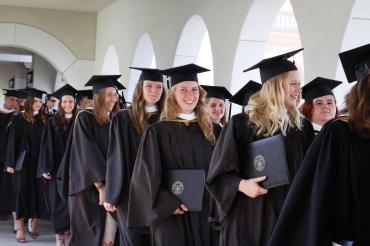 What Can You Do with a Liberal Education?
Nothing speaks more to the versatility of the College’s academic program than the good that our alumni are doing throughout the Church and the world.


Alumna Dr. Kathleen Sullivan (’06) Delivers Talk on Austen’s Use of Letters
Typically, Wednesday afternoon “Tutor Talks” at Thomas Aquinas College are presented by members of the teaching faculty, but last Wednesday, students on the California campus enjoyed a special treat: a talk and discussion from a visiting scholar. Returning to her alma mater while on sabbatical, Dr. Kathleen Sullivan (’06), an associate professor of English and literature at Christendom College, spoke on the subject, “Revelation of Interiority: The Epistolary Presence in Jane Austen’s Pride and Prejudice.”
After graduating from Thomas Aquinas College in 2006, Dr. Sullivan earned a master’s degree in English from the University of Dallas and a doctorate from the Catholic University of America. In her talk last week, she drew upon these studies while discussing the epistolary genre of literature in the 1700s, a style which initially utilized letters as a means to reveal the interior life of the letter-writer: “a shortcut to the heart,” so named by a critic. However, in the early 1800s, when Austen’s Pride and Prejudice was published, the literary function of letters shifted its focus from revealing movements of the heart to instigating external, social conflict.
In her talk, Dr. Sullivan aimed to emphasize that “Austen does have continuity with the earlier tradition; she does use letters to reveal interiority.” Through a graceful and insightful dissection of Mr. Darcy’s notorious letter to Elizabeth Bennet, Dr. Sullivan highlighted the subtle and intentional “undercurrents of emotional awareness and internal struggle” placed by Austen throughout the letter — and what these reveal about Mr. Darcy’s heart.
Although Austen depicts Mr. Darcy as a characteristically proud and arrogant man, his letter reveals a layer of vulnerability and care for those around him, especially for his friends, his family, and Elizabeth. Subsequently, in reading his letter, Elizabeth perceives the true depth of Mr. Darcy’s character, so that she undergoes a change of heart as a result. Elizabeth “not only had access to the logic of his mind,” Dr. Sullivan observed, “but she was given a glimpse into his heart; and it moved her.”
To conclude her analysis, Dr. Sullivan reiterated, “By using the epistolary form as a mode of defense and an authentic confession of his feelings — however brief — Austen kept the form of the original purpose: to focus on the inner life of the letter writer, while using it also toward her ultimate purpose of bringing happiness to her characters and their marital union.”