-
About
 Fidelity & Excellence
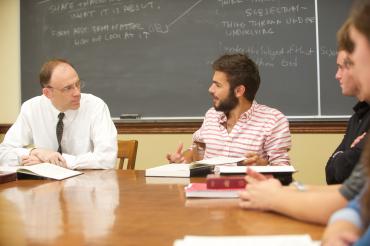
Thomas Aquinas College is unique among American colleges and universities, offering a faithfully Catholic education comprised entirely of the Great Books and classroom discussions.
-
A Liberating Education
 Truth Matters
Truth, and nothing less, sets men free; and because truth is both natural and supernatural, the College’s curriculum aims at both natural and divine wisdom.
-
A Catholic Life
 Under the Light of Faith
The intellectual tradition and moral teachings of the Catholic Church infuse the whole life of Thomas Aquinas College, illuminating the curriculum and the community alike.
-
Admission & Aid
 Is TAC Right for You?
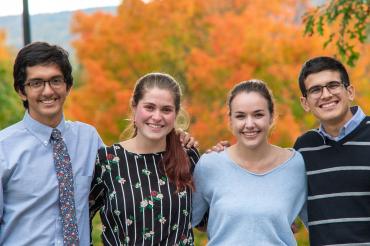
Do you enjoy grappling with complex questions? Are you willing to engage in discussions about difficult concepts, with the truth as your ultimate goal?
-
Students & Parents
 Mind, Body & Spirit
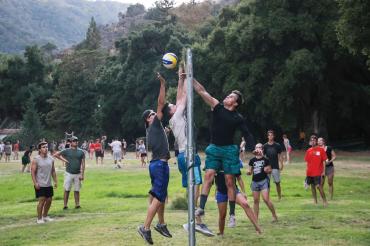
There is always something to do at TAC — something worthwhile, something fulfilling, and something geared toward ever-greater spiritual and intellectual growth.
-
Alumni & Careers
 What Can You Do with a Liberal Education?
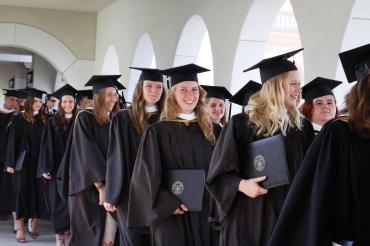
Nothing speaks more to the versatility of the College’s academic program than the good that our alumni are doing throughout the Church and the world.


Dr. Stephen Barr Clarifies Conflict Between Science and Religion
For the last lecture of the 2025-26 St. Vincent de Paul Lecture and Concert Series at Thomas Aquinas College, Catholic author and scientist Dr. Stephen Barr came to the New England campus to speak on “Science and Religion: The Myth of Conflict.”
Dr. Barr began his lecture by laying out the conflict as it exists in our present society, questioning how science and religion can be reconciled as congruous. He advanced that the most common issue and cause of the conflict is the failure to distinguish between true science and scientific materialism. Scientific materialism seems in some ways to be implied by modern science, as many prominent atheistic scientists believe that all reality is reducible to matter.
If one reduces science and the study of the natural world to matter alone, no room is left for a cause or creator. “If matter were the only reality, then of course God would not exist, nor would human spiritual souls,” said Dr. Barr. “A human being would be no more than a complex structure made of atoms, and everything about a human being would be ultimately explicable in terms of the laws of physics that govern how those atoms behave.” This conception of science, coupled with arguments accusing religion of being hostile or suppressive towards science, has led to a perceived opposition between the two.
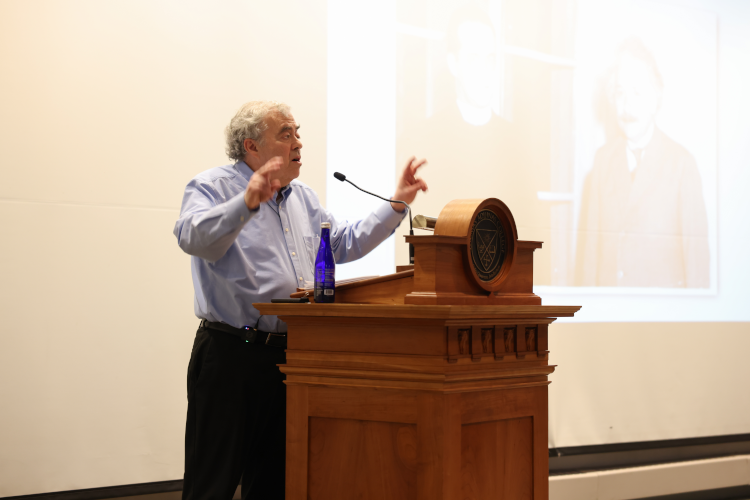
As a result, Dr. Barr explained, we are faced with the seeming disparity between the naturalism of science and the supernaturalism of religion: one seems to deal entirely with the natural and material, the other with the causal and divine; the two appear incompatible and unrelated. On the contrary, science and religion go hand in hand, as we see from nature’s laws and patterns. “There must be a giver of order and a giver of being,” Dr. Barr said. “The fundamental reasons for a creator are that there must be a cause of the universe's existence and order, and if there is law, there must be a lawgiver.”
Man has come to see God as being in competition with nature, instead of being nature’s author, making a black and white distinction between nature and its Creator, as all things are labeled as either definitively natural or supernatural. “In the gaps in our scientific understanding we look for God, instead of relating the two,” Dr. Barr explained. We ought to see the God made manifest in His creation itself and recognize that He can work in both natural ways — through secondary natural causes — or through directly supernatural means, such as miracles. Thus, Dr. Barr explained that “God is not a part of the physical universe; He is the ultimate cause, not in nature, but of nature.”
Dr. Barr concluded his talk with an overview of religious and scientific men working together throughout history, highlighting influential priests from the Scientific Revolution to World War II who made revolutionary contributions to modern science while remaining deeply devout. His last argument was for the state of the universe being a precondition for man’s existence, and that mankind must be intentional and not accidental.
After the lecture, the audience applauded, then moved to the library for an animated question-and-answer session. All were intrigued and inspired with queries and opinions about quantum physics, the multiverse scenario, and more. “Dr. Barr was one of the most educated and interesting lecturers I have listened to,” said Stephen King (NE’26). “He spoke very well and convinced me even more firmly of his claims.”
| Receive lectures and talks via podcast! | ||||
|---|---|---|---|---|
 |
 |
 |
 |
 |