-
About
 Fidelity & Excellence
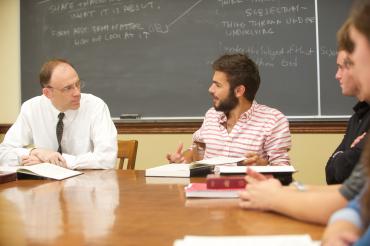
Thomas Aquinas College is unique among American colleges and universities, offering a faithfully Catholic education comprised entirely of the Great Books and classroom discussions.
-
A Liberating Education
 Truth Matters
Truth, and nothing less, sets men free; and because truth is both natural and supernatural, the College’s curriculum aims at both natural and divine wisdom.
-
A Catholic Life
 Under the Light of Faith
The intellectual tradition and moral teachings of the Catholic Church infuse the whole life of Thomas Aquinas College, illuminating the curriculum and the community alike.
-
Admission & Aid
 Is TAC Right for You?
Do you enjoy grappling with complex questions? Are you willing to engage in discussions about difficult concepts, with the truth as your ultimate goal?
-
Students & Parents
 Mind, Body & Spirit
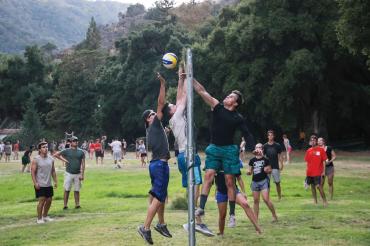
There is always something to do at TAC — something worthwhile, something fulfilling, and something geared toward ever-greater spiritual and intellectual growth.
-
Alumni & Careers
 What Can You Do with a Liberal Education?
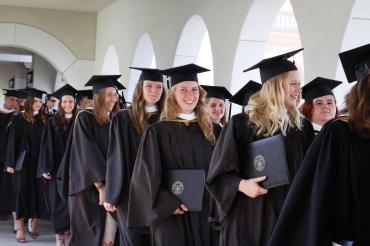
Nothing speaks more to the versatility of the College’s academic program than the good that our alumni are doing throughout the Church and the world.


Dr. John Nieto (’89) Ponders Wisdom in Men’s Dorm Talk
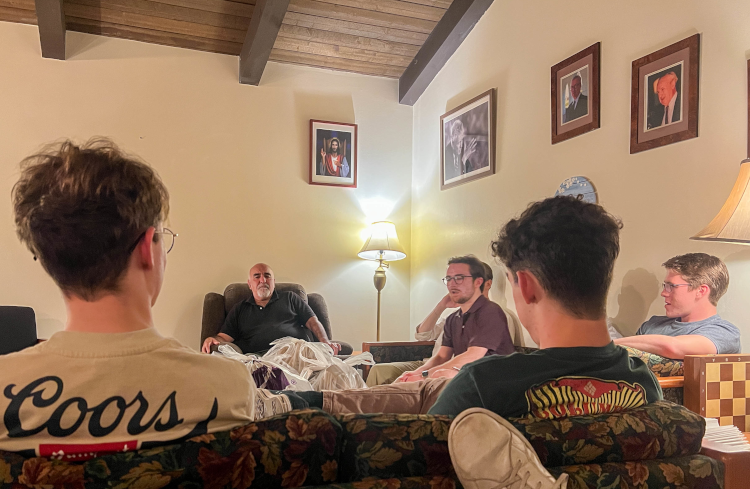
The men of Thomas Aquinas College, California, welcomed beloved tutor Dr. John Nieto (’89) into St. Peter & Paul’s Hall on a recent Friday night for an informal dorm talk. Immediately after dinner, a crowd gathered in the the residence hall’s common room to hear Dr. Nieto answer the question: “What is wisdom?”
Throughout their time at the College, students grapple with different accounts of wisdom, both Scriptural and Aristotelian. Scripture speaks highly of wisdom, but in an obscure manner. Aristotle, in turn, defines wisdom as “a science about the first causes of things.” However, many different sciences deal with the first causes of things in one way or another; Euclid’s geometry, or Newton’s physics, for example. Wisdom must be more specific. “In our pursuit of the subject of wisdom, then, we are really looking for a nature that is able to cause all the other things that we know,” explained Dr. Nieto.
Following the line of thought from ancient Greek philosophers, Dr. Nieto began by considering matter and form. Form gives shape and consequently makes everything knowable to the human intellect. For this reason, the Platonists believed that form is apt to be a first cause. The soul is a particular example of form, one which acts as a life-giving, unifying force. “Somehow life belongs to the whole being in a way that is superior to the motion of its parts,” Dr. Nieto said. “The acts of the cell do not belong to particular molecules, but in some sense belong to the whole, ordering different molecules to an act that is one.”
The soul is the principle not only of motion, but also of knowing. Sensing and understanding both fall under this category, and what distinguishes these acts of knowing from physical motion is that “union with the end is what causes continuation”; because of that, “this operation is in principle eternal.” Dr. Nieto demonstrated this phenomenon using the sense of sight: “I may not see forever, because my eyes will wear out; but it is only because my eyes are going to wear out that I am not going to see forever.” The sense power in itself never deteriorates. Such is the case with the intellect, as well: the intellectual power is unable to corrupt.
Dr. Nieto also provided a few proofs that the intellect transcends the limits of time and place. Form, generally, gives shape and the ability to be known; soul, a type of form, gives life and unity; and the intellect gives understanding, and — as Dr. Nieto showed — can even transcend the bounds of time and place. It seems fitting that something of this nature is the first cause of all knowable things and, subsequently, the end of wisdom. And what is this being if not God?
The brief talk was followed by a lengthy question-and-answer session, which covered a variety of topics related to wisdom, including form as the first principle of things, as opposed to matter; an account of the soul, and how we understand; and, eventually, segued into an animated theological discussion.