-
About
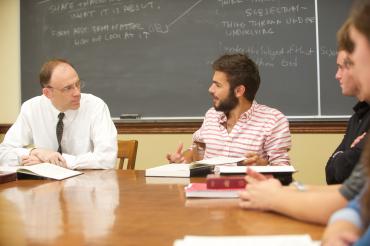 Fidelity & Excellence
Thomas Aquinas College is unique among American colleges and universities, offering a faithfully Catholic education comprised entirely of the Great Books and classroom discussions.
-
A Liberating Education
 Truth Matters
Truth, and nothing less, sets men free; and because truth is both natural and supernatural, the College’s curriculum aims at both natural and divine wisdom.
-
A Catholic Life
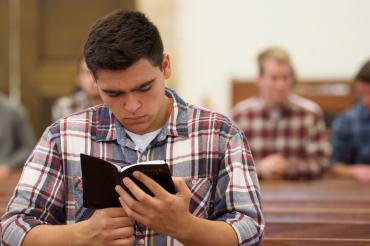 Under the Light of Faith
The intellectual tradition and moral teachings of the Catholic Church infuse the whole life of Thomas Aquinas College, illuminating the curriculum and the community alike.
-
Admission & Aid
 Is TAC Right for You?
Do you enjoy grappling with complex questions? Are you willing to engage in discussions about difficult concepts, with the truth as your ultimate goal?
-
Students & Parents
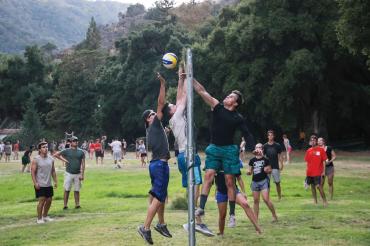 Mind, Body & Spirit
There is always something to do at TAC — something worthwhile, something fulfilling, and something geared toward ever-greater spiritual and intellectual growth.
-
Alumni & Careers
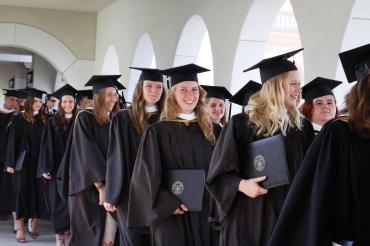 What Can You Do with a Liberal Education?
Nothing speaks more to the versatility of the College’s academic program than the good that our alumni are doing throughout the Church and the world.


TAC Launches New Podcast Series on Aquinas & AI
“Can artificial intelligence truly think and understand, just as the human mind does?”
So asks Dr. Michael Augros (’92), a member of the teaching faculty at Thomas Aquinas College, New England, in The Mind and the Machine, a new, 10-part video podcast series on artificial intelligence.
“If we want to understand what AI is in a way that clarifies the difference between it and ourselves — and from that, to discern what roles it should and should not play in human life — then we need philosophy and theology.”
Over the course of the podcast, Dr. Augros breaks down the Thomistic philosophy on the mind and its incorporeal nature. In easy-to-follow arguments, he presents the topic in a manner accessible to anyone with an interest in this timely and critical question.
“Viewers can expect a clear, high-level introduction to what AI is, especially the kind of systems we now call Large Language Models (such as ChatGPT), and how they actually work,” explains Dr. Augros. “They will also get a close look at Aquinas’s account of living things and of human cognitive powers — an account that grounds the series’ argument that not only current AI, but AI in principle, cannot truly think or understand except in a metaphorical sense, impressive as its abilities may be. Finally, viewers will encounter arguments from both sides: those who claim that AI can genuinely perceive, emote, think, and understand, and those who deny it.”
In the series’ first episode, Dr. Augros considers the importance of analyzing artificial intelligence from a philosophical — and theological — perspective. Among the many questions one could ask about AI, he focused on the question of its sentience and personhood to define properly what it is and to point out the fundamental difference between it and man.
“If we want to understand what AI is in a way that helps us build applications, then the technical field of AI is the right place to look,” Dr. Augros says. “But if we want to understand what AI is in a way that clarifies the difference between it and ourselves — and from that, to discern what roles it should and should not play in human life — then we need philosophy and theology. Only they can address the deeper questions about mind, soul, personhood, and the proper place of our own creations within the larger moral and intellectual order.”
The first episode of The Mind and the Machine — as well as all those to come, once per week for the next nine weeks — are available on the Thomas Aquinas College website, as well as on YouTube and all major podcasting platforms.