-
About
 Fidelity & Excellence
Thomas Aquinas College is unique among American colleges and universities, offering a faithfully Catholic education comprised entirely of the Great Books and classroom discussions.
-
A Liberating Education
 Truth Matters
Truth, and nothing less, sets men free; and because truth is both natural and supernatural, the College’s curriculum aims at both natural and divine wisdom.
-
A Catholic Life
 Under the Light of Faith
The intellectual tradition and moral teachings of the Catholic Church infuse the whole life of Thomas Aquinas College, illuminating the curriculum and the community alike.
-
Admission & Aid
 Is TAC Right for You?
Do you enjoy grappling with complex questions? Are you willing to engage in discussions about difficult concepts, with the truth as your ultimate goal?
-
Students & Parents
 Mind, Body & Spirit
There is always something to do at TAC — something worthwhile, something fulfilling, and something geared toward ever-greater spiritual and intellectual growth.
-
Alumni & Careers
 What Can You Do with a Liberal Education?
Nothing speaks more to the versatility of the College’s academic program than the good that our alumni are doing throughout the Church and the world.


Tutor Talk: Andreas Waldstein (’19) Defines the Sublime
A first-year Thomas Aquinas College tutor, Andreas Waldstein (’19) recently delivered his first-ever “Tutor Talk,” on the subject, “Toward a Thomistic Theory of the Sublime.”
Mr. Waldstein, who teaches on the California campus, described the phenomenon of sublimity as “an experience in which we feel fear on the one hand, but on the other hand a kind of delight, in contemplating the greatness and power of things.” The all-consuming awe we feel in beholding a magnificent mountain, a towering wave, or an impending storm — and the consequent elevation of our minds to the greatness of the universe — results from a “sublime” quality in nature. But how do we define sublimity, and what is its cause? Is it distinct from beauty?
To begin answering these questions, Mr. Waldstein presented the subliminal opinions of philosophers Edmund Burke, Immanuel Kant, and Friedrich Schiller. While Burke characterized the sublime as a feeling of terror, Kant and Schiller developed the view that the sublime is found not in the object, but rather, in the human mind; a great object, in overwhelming our senses, awakens our reason, and sparks a sort of intellectual daring within us. This awakening, for Kant, is sublimity. “I think Kant is completely wrong to think that the sublime is in us, rather than in things,” commented Mr. Waldstein. “It’s the stars themselves that are sublime. What seems right in Kant’s account is that part of the joy of contemplating the stars is feeling an increase of that daring power.”
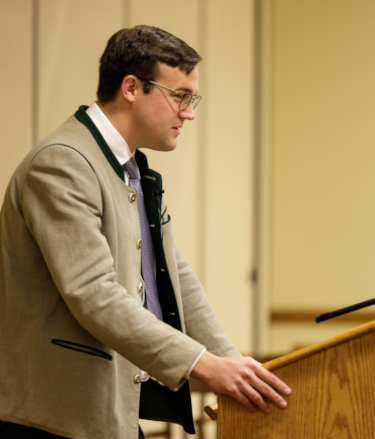 Mr. Waldstein then offered three ideas to assist the contemplation of sublimity. First, he drew from St. Thomas Aquinas’s teaching on the dual reality of revelation and concealment within objects, noting that “beautiful things delight us because they reveal their forms to us in an excellent way,” whether through their symmetry, clarity, or vibrance. But for the limited minds of men, all revealed beauty necessarily brings with it a concealment, like a veil on the altar. “It makes us understand what it contains; and it makes us understand that what it contains exceeds what we can understand.” Sensibles, in this way, are a kind of veil for intelligibles. Similarly, the splendors of nature are sublime according to the degree that they manifest God’s awesomeness to us and yet conceal Him, calling to mind His mystery.
For the second idea, Mr. Waldstein discussed man’s natural hunger to uncover the causes, especially the cause of nature. A man need not believe in God to experience sublimity; there is something internal that draws him to it. In this way, the atheist astronomer is able to engage with the divine source of his study. “He won’t be able to contemplate the Divine as such,” explained Mr. Waldstein, “but he will have a feeling for some deeper meaning, which is, in fact, God.”
Finally, Mr. Waldstein presented a third view: that the sublime engages the spirited, irascible side of man. This approach distinguishes sublimity from simple beauty, which is associated only with the concupiscible appetite, or the desiring side. “The irascible passions move us toward the good, or away from the evil, considered as arduous, or difficult,” said Mr. Waldstein. A stormy ocean or a vast canyon poses difficulty to our imagination because of its magnificence, drawing us in. “The exultation that we feel on a mountain top — that must be a kind of daring or a kind of confidence.”
What, then, is sublimity? Identifying the issues in the philosophers’ accounts, and drawing from the three views he outlined, Mr. Waldstein defined the sublime as “arduous beauty.” An object is sublime when it sparks a sort of daring in us: All people have at one point felt a swell in their chests when beholding a sky-scraping mountain or a fiery sunset. The harshness within a thing that sparks this reaction is also indicative of a higher order that transcends our understanding, which we yet long to know. “The sublime makes us humbly recognize our smallness in the sight of God,” Mr. Waldstein concluded, “but also it makes us magnanimously able to recognize His beauty.”
| Receive lectures and talks via podcast! | ||||
|---|---|---|---|---|
 |
 |
 |
 |
 |