-
About
 Fidelity & Excellence
Thomas Aquinas College is unique among American colleges and universities, offering a faithfully Catholic education comprised entirely of the Great Books and classroom discussions.
-
A Liberating Education
 Truth Matters
Truth, and nothing less, sets men free; and because truth is both natural and supernatural, the College’s curriculum aims at both natural and divine wisdom.
-
A Catholic Life
 Under the Light of Faith
The intellectual tradition and moral teachings of the Catholic Church infuse the whole life of Thomas Aquinas College, illuminating the curriculum and the community alike.
-
Admission & Aid
 Is TAC Right for You?
Do you enjoy grappling with complex questions? Are you willing to engage in discussions about difficult concepts, with the truth as your ultimate goal?
-
Students & Parents
 Mind, Body & Spirit
There is always something to do at TAC — something worthwhile, something fulfilling, and something geared toward ever-greater spiritual and intellectual growth.
-
Alumni & Careers
 What Can You Do with a Liberal Education?
Nothing speaks more to the versatility of the College’s academic program than the good that our alumni are doing throughout the Church and the world.



Tutor Talk: Dr. John McCarthy (’11) Examines Thucydides as Philosopher
Last week marked the last of the freshman seminars at TAC-New England on the ancient Greek historian Thucydides, so Wednesday’s Tutor Talk from Dr. John McCarthy’s (’11), “Thucydides as a Philosopher,” came at the perfect time.
Dr. McCarthy began by spelling out the distinctions between history, poetry, and philosophy, arguing that Aristotle measures history and poetry by their proximity to philosophy. Poetry deals with construction of a narrative that is not tied to reality or definitive sequential events, and thus is philosophical in nature. Furthermore, he posited that poetry imitates history in order “to secure conviction; historical accuracy persuades more effectively than what appears purely imagined.” But history is the most effective in producing this conviction, as its accuracy is grounded in reality itself.
He went on to explain that Thucydides’ pursuit of accuracy gives his histories credibility and impact, since he says nothing for the sake of mere embellishment, but with constant purpose in mind. “Thucydides aims to teach,” Dr. McCarthy remarked. “Accuracy in the particulars is not an end in itself; human nature staying the same, human action will exhibit discernible patterns.” By witnessing and noting these patterns, man — the most imitative of animals — may learn from mistake or success.
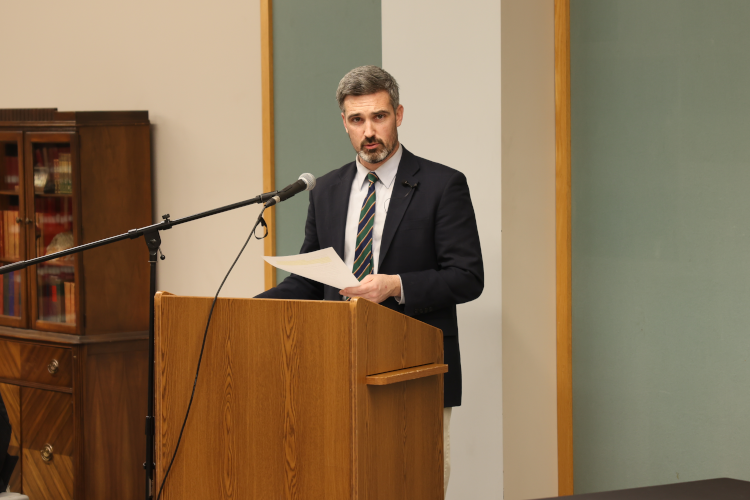
Thucydides’ work guides readers in the examination of the future, inquiring why human events turn out the way that they do. “Although men are motivated by belief in divine justice and providence, and change behavior based on natural disasters and wonders, as far as the human eye can see, historical events are the result of human foresight or its failure.” For this reason, Thucydides records the Peloponnesian War as it exhibits the polarities of human nature on both sides, presenting his philosophy of the causes of human events.
Violence is a natural necessity of war, as war itself teaches violence through violence, showing men who they truly are when everything has been stripped away. “For Thucydides, it is as if men are more truly what they are when all that they have intentionally established to restrain the basest parts of their nature are abolished,” Dr. McCarthy claimed. “The habits we have formed by means of rationally chosen culture, law, and custom are not what make us what we are, but what we pretend to be.” Thucydides shows the repeating pattern of man’s human nature, presenting a tragic history devoid of providence.
“We have argued that Thucydides presents a philosophy through asserted accuracy, dialectical contrast, and tragic narrative,” said Dr. McCarthy in summation. “Thucydides claims to expose the universal patterns of human behavior arising from man’s unchanging nature … [making] a dialectical inquiry into prudence, power, justice, providence and necessity.” We are unlikely to understand our own reading of human nature and events without seeing its opposite, and so we read Thucydides. Thus, we may appreciate the lives that we are so blessed to live and the laws that hold them firmly in place.
As Dr. McCarthy’s talk concluded, the audience applauded and moved into a question-and-answer session. “It was quite a comprehensive critique of Thucydides’ philosophy,” said John Morningstar (NE’29), “and an interesting view into expediency vs. justice in the War of the Hellenes.” Agreed Vitor Satcheki (NE’28): “I thought it was interesting the way he considered Thucydides’ points of view on religiosity and its implications on other nations, as compared with other historians we read. Excellent, overall!”