-
About
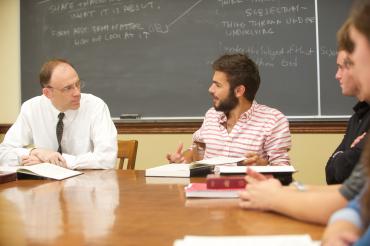 Fidelity & Excellence
Thomas Aquinas College is unique among American colleges and universities, offering a faithfully Catholic education comprised entirely of the Great Books and classroom discussions.
-
A Liberating Education
 Truth Matters
Truth, and nothing less, sets men free; and because truth is both natural and supernatural, the College’s curriculum aims at both natural and divine wisdom.
-
A Catholic Life
 Under the Light of Faith
The intellectual tradition and moral teachings of the Catholic Church infuse the whole life of Thomas Aquinas College, illuminating the curriculum and the community alike.
-
Admission & Aid
 Is TAC Right for You?
Do you enjoy grappling with complex questions? Are you willing to engage in discussions about difficult concepts, with the truth as your ultimate goal?
-
Students & Parents
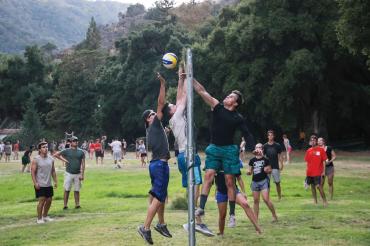 Mind, Body & Spirit
There is always something to do at TAC — something worthwhile, something fulfilling, and something geared toward ever-greater spiritual and intellectual growth.
-
Alumni & Careers
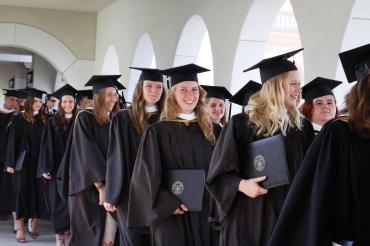 What Can You Do with a Liberal Education?
Nothing speaks more to the versatility of the College’s academic program than the good that our alumni are doing throughout the Church and the world.



Ambassador Brian F. Burch II’s Address to the Class of 2026
“Become Peacemakers in an Age of Confusion”
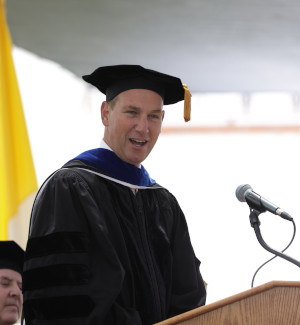
by The Honorable Brian F. Burch II
United States Ambassador to the Holy See
Commencement 2026
Thomas Aquinas College, California
Priests and religious, President O’Reilly, distinguished faculty, honored guests, proud parents and families, and most especially, you — the graduates of Thomas Aquinas College — good morning, and congratulations!
It is a joy and an honor to be with you on this remarkable day. This day is particularly remarkable for me personally, as it marks my first trip back to the United States since assuming my responsibilities in Rome last August. And, to be honest, it feels a little bit like a vacation.
Commencements are always moments of gratitude and hope: gratitude for everything that brought us here — sacrifices, prayers, late nights, and lots of coffee — and hope for the adventure that now awaits you, the graduates.
Here at Thomas Aquinas College, Commencement carries a particular kind of amazement. If you had described this place 50 years ago to a credentialed educational consultant, he probably would have questioned your sanity:
“You’re founding a Catholic college … with no departments … no electives … no majors … students reading original texts … discussing Euclid and Aristotle by seminar … undergraduates doing four years of philosophy and theology … and you think this will survive … in California?”
And yet, here you are — not only surviving, but flourishing.
St. Thomas Aquinas once wrote that the intellectual life begins in wonder. The founders of this college clearly possessed enough wonder — along with courage and conviction — to believe that young men and women were still capable of seeking truth seriously. That was not a fashionable assumption in 1971, and it certainly is not fashionable today.
The modern university promises students three things: credentials, specialization, and the lure of a productive career. This institution proudly offers something older and far more demanding: truth, intellectual curiosity, and the formation of the soul.
Which explains why alumni often leave this place with two simultaneous convictions: first, that they have learned an extraordinary amount — and second, that they suddenly realize how little they know. That, incidentally, is one of the surest signs of a genuine education.
This college has insisted, decade after decade, that the purpose of education is not merely to produce successful people, but free people — free because they have learned what it means to order their loves toward what is true and good, for the sake of themselves and for the world they will inhabit.
Perhaps that is why this Commencement arrives at such an interesting moment in our national life. Two-hundred-and-fifty years ago this summer, 56 courageous signers placed their names on a piece of parchment, risking their lives, their homes, their wealth, and their sacred honor to declare to the world that all men are created equal, endowed by their Creator with certain unalienable rights — among these are life, liberty, and the pursuit of happiness. On July 4, our nation will celebrate more than simply a birthday or an abstract theory written on a piece of paper.
This Independence Day, perhaps more than in recent memory, allows us to celebrate the endurance of our American way of life — a particular people with a unique shared history, tradition, land, and culture. America is our home. G.K. Chesterton captured this insight in the 1920s, calling America “a nation with the soul of a church.”
“The modern university promises students three things: credentials, specialization, and the lure of a productive career. This institution proudly offers something older and far more demanding: truth, intellectual curiosity, and the formation of the soul.”
But it would be a mistake to understand this fact of history as mere luck or accident. The Declaration of Independence appeals not only to human reason, but to “the Laws of Nature and of Nature’s God.” It speaks of rights given by a Creator and closes with “a firm reliance on the protection of divine Providence.”
The word “providence” itself comes from the Latin: pro, meaning “ahead,” and videre, meaning “to see.” God sees ahead of us. The tradition of the Church understands this as God’s eternal nature seeing all of time and all things as present — including the smallest details of the universe — and, by way of nature and grace, He orders all things accordingly.
God, in His providence, saw ahead your coming into being, your first steps, your First Communion, and the moment you said goodbye to your parents — perhaps for the first time — to embark on your education at Thomas Aquinas College. And God’s Divine Providence will continue to see ahead as you begin your pilgrimage into a world that desperately needs what your education here has formed in you: minds sharpened by truth, hearts enlarged by beauty, and souls anchored in the good.
You have studied the Great Books of Western civilization, including theology, with its handmaid, philosophy. You have contemplated the sciences and the arts, and above all, you have grown in your relationship with Christ in the sacraments of the Church and with one another. As you step into the world, I want to speak with you about something both ancient and new: peace.
Not the fragile absence of conflict that the evening news calls “peace,” nor the superficial calm of a well-curated social media feed, or some nature worship or sentimental humanitarianism. But the deep, ordered peace that St. Augustine described as tranquillitas ordinis — the tranquility of order.
In his monumental work The City of God, written amid the chaos of Rome’s decline, Augustine reminds us: "The peace of all things is the tranquility of order. Order is the distribution which allots things equal and unequal, each to its own place."
Peace, for Augustine, is not the silencing of all discord. It is the harmonious arrangement of creation — within the human heart, within families and communities, within nations, and ultimately within the cosmos — according to the wise design of the Creator.
Augustine understood peace not as passive surrender to circumstances, but as rightly ordered love. Peace is not pretending evil does not exist. Peace is not withdrawal from responsibility.
Peace is not indifference disguised as sophistication. Peace requires vigilance because the human heart is never morally neutral.
He also understood something far more demanding: Peace requires moral clarity. Evil does not prevail merely because of violent people. It prevails when good people become distracted, indifferent, or lack courage.
A society loses peace when people stop defending truth, stop protecting the vulnerable, or stop believing that evil and injustice must be restrained. For Augustine, peace was never simply a feeling. It was the work of rightly ordered love — and love, if it is real, always moves outward. It is fruitful. It sacrifices. It builds. It acts.
Augustine believed that every human being loves something. The central moral question is not whether we love, but whether we love the right things, in the right order, and in the right measure. When love is rightly ordered, the restless heart finds rest. Augustine knew this from personal experience. In his Confessions, he chronicles a young man’s search for peace in ambition, sensual pleasure, intellectual pride, and even in a seemingly noble career. "Our hearts are restless,” he wrote “until they rest in You."
Yet Augustine was no escapist. As Bishop of Hippo, he engaged in politics, defended the vulnerable, debated heretics, and contributed much-needed wisdom in reconciling how political authorities must act to defend the common good, even where force can be compatible with charity in a violent, unstable world.
He wrote that Christians live as pilgrims in the earthly city while belonging ultimately to the City of God. In that tension, we labor for proximate peace — tranquility among nations and citizens, manifested in just laws, virtuous families, and rightly formed souls — while never confusing it with what Augustine called “the perfectly ordered and harmonious enjoyment of God, and of one another in God.”
“A society loses peace when people stop defending truth, stop protecting the vulnerable, or stop believing that evil and injustice must be restrained.”
This pursuit of peace, rightly understood, is worth reflecting on as we celebrate the Semiquincentennial of the United States. The aim of the Declaration, and the prudence and wisdom of our system of government, seeks, above all, tranquillitas ordinis — even the Preamble to our Constitution includes this purpose: to establish Justice, provide for the common defense, promote the general welfare, and to insure domestic tranquility.
This Augustinian vision has profoundly shaped both Catholic thought and our own experience as Americans. A well-ordered society requires well-formed citizens, shaped by moral and religious faith. It includes the vocation of marriage and family, dignified work, and public service. In the 20th century, amid two world wars, authoritarian and totalitarian regimes, and the threat of nuclear annihilation, brave men and women offered the ultimate sacrifice in pursuit of peace.
A country where, in 1943, in my hometown of Chicago, a young college graduate would be commissioned into the United States Navy. By June of 1944, he would serve in the allied armada assembled for Operation Overlord. On D-Day, June 6, he took part in the Normandy invasion, helping deliver troops to the heavily defended French coast. Later, this young man of faith also participated in Operation Dragoon, the allied invasion of southern France. Later in life, he described the significance of May 8, 1945, when he found himself in Rome on VE Day — marking the unconditional surrender of Nazi Germany.
Exactly 80 years later — to the day — on May 8, 2025, this young Navy lieutenant’s son, Robert, an Augustinian, would be elected the first American pope. Appearing for the first time on the loggia of St. Peter’s Square and taking the name Leo XIV, his first words to the world were: "Peace be with you."
Pope St. John XXIII, in Pacem in Terris, built explicitly on Augustinian and Thomistic foundations when he insisted that true peace flows from justice, rooted in the dignity of the human person. In the aftermath of World War II, the Pope called for an international public authority that could promote peace and safeguard human dignity on a global scale. Later, Pope Benedict XVI echoed that aspiration, advocating for a genuine political authority capable of coordinating international life. The aim was contained in the title of John XXIII’s encyclical: peace on earth.
The challenge, of course, has been one of prudence — namely, how best to empower multilateral institutions that still respect national sovereignty, justly allocate responsibilities and obligations, and avoid manipulation or exploitation by rogue nations. International norms, for example, failed to stop Russia from seizing Crimea in 2014 and its full-scale invasion of Ukraine in 2022. They also proved unable to contain Iran’s pursuit of nuclear weapons or its expansion of regional terror networks. Global institutions and international cooperation remain important, if at times idealistic, frameworks — but they are still subject to the limitations of the city of man.
What remains necessary is moral clarity and moral courage, particularly from leaders and nations best equipped to pursue peace, rightly understood. Here I may be biased, but it could be said that, when it comes to peace, the two most important sovereign institutions in our world today are the United States of America and the Holy See.
The United States, of course, possesses unmatched military, economic, and diplomatic power, allowing it to deter adversaries, support international alliances, and provide economic and humanitarian aid. The Church invests the prudential exercise of moral authority in the legitimate sovereign: the democratically elected president of our country.
The Holy See, by contrast, wields soft power in the form of moral and spiritual authority, promoting human dignity while urging reconciliation and dialogue. Both are necessary, representing complementary forces — one grounded in geopolitical power, the other in ethical and moral persuasion. Both are needed to achieve tranquillitas ordinis.
Yet a broader point must also be made: Peace cannot be sustained by institutions alone. Pope St. John Paul II echoed Augustine when he taught, “No peace without justice.” He confronted communism and consumerism, and reminded the world that disordered loves breed violence — against society and the soul alike.
Pope Benedict XVI likewise emphasized that peace is not merely a political achievement but a fruit of conversion. A society that forgets God inevitably disorders itself: it elevates the self or the state above the common good, leading to fragmentation rather than harmony.
Now, dear graduates, why does all of this matter for your lives?
You are entering a world that markets countless counterfeit versions of peace. Social media promises connection but often delivers synthetic pleasure and outrage. Career success promises security but frequently demands the sacrifice of integrity, family, or faith. Consumer culture promises happiness through accumulation but leaves souls hollow, while weak political leadership breeds chaos and disorder.
In this environment, your formation here at Thomas Aquinas has equipped you uniquely to resist these illusions and to become both examples and advocates of genuine peace.
“When it comes to peace, the two most important sovereign institutions in our world today are the United States of America and the Holy See.”
First, begin with the interior order of your own heart. A rightly ordered heart radiates outward. You will bring peace to your future workplaces not primarily by avoiding conflict, but by modeling integrity, treating colleagues with dignity, and pursuing excellence as service rather than
self-promotion. In your families and the communities you join, you will foster peace through leadership, humility, forgiveness, and sacrificial love.
Second, you have been formed to think critically and charitably. Use that formation to promote justice that respects the full dignity of every person — from the unborn to the elderly, from our working class to men and women who serve in our armed forces. Advocate for policies, practices, and political leadership that protect the common good rather than ideology or sentimentality — but do so with the realism of Augustine: Expect imperfect results in the earthly city, and never despair.
Third, become peacemakers in an age of confusion. Our culture suffers from disordered loves writ large: the elevation of autonomy over relationship, pleasure over responsibility, power over the gift of self. You can counter this in small but powerful ways — through authentic friendships, through creative work that honors beauty and truth, and through service to those your particular vocation calls you to serve. Get married. Have children. Build a home. Do acts of charity, especially among those closest to you. Create and celebrate good art and music. Continue to read good books. Perhaps even write one. Join the foreign service. Build cathedrals.
Finally, remember that the peace you seek and offer is ultimately a gift, not an achievement. Graduates, the education you received here — rooted in the Catholic intellectual tradition — has not been a luxury. It has been preparation for this very mission: to seek the tranquility of order in your souls, and to labor, with hope and perseverance, for a more just and peaceful world.
As you leave this campus, carry with you the wisdom of Augustine and the formation you have received in virtue, faith, and reason. The world needs you. It needs young men and women who know that true peace is not the absence of struggle, but the hard work, discipline, and courage of rightly ordered love.
So go forth, Class of 2026. Be joyful. Be brave. Be vigilant. Love this country enough to tell her the truth. Love your Church enough to live her teachings with integrity. Love your spouse and neighbor enough to lay down your life in small, daily ways. And never forget that our republic’s survival — and, more importantly, the salvation of souls — depends not on distant institutions, but on hearts set on fire with the love of Christ.
May the Blessed Virgin Mary, patroness of our nation under her title of the Immaculate Conception, and Saints Louis and Marie-Azelie Martin, intercede for you. May the Holy Spirit grant you wisdom, courage, and perseverance. And may Almighty God bless you, your families, and this great nation on its 250th birthday — now and for generations to come.
Congratulations, graduates. For the greater glory of God, go forth now — in peace.
| Receive lectures and talks via podcast! | ||||
|---|---|---|---|---|
 |
 |
 |
 |
 |