-
About
 Fidelity & Excellence
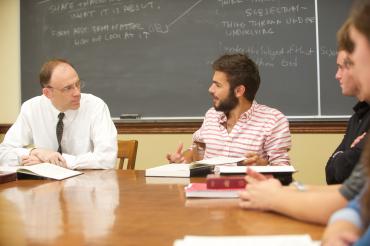
Thomas Aquinas College is unique among American colleges and universities, offering a faithfully Catholic education comprised entirely of the Great Books and classroom discussions.
-
A Liberating Education
 Truth Matters
Truth, and nothing less, sets men free; and because truth is both natural and supernatural, the College’s curriculum aims at both natural and divine wisdom.
-
A Catholic Life
 Under the Light of Faith
The intellectual tradition and moral teachings of the Catholic Church infuse the whole life of Thomas Aquinas College, illuminating the curriculum and the community alike.
-
Admission & Aid
 Is TAC Right for You?
Do you enjoy grappling with complex questions? Are you willing to engage in discussions about difficult concepts, with the truth as your ultimate goal?
-
Students & Parents
 Mind, Body & Spirit
There is always something to do at TAC — something worthwhile, something fulfilling, and something geared toward ever-greater spiritual and intellectual growth.
-
Alumni & Careers
 What Can You Do with a Liberal Education?
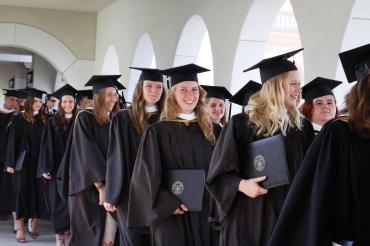
Nothing speaks more to the versatility of the College’s academic program than the good that our alumni are doing throughout the Church and the world.



Class Speaker: “The Madness of Our Chase for Wisdom”
by Liam O’Brien (NE’26)
Senior Address
Commencement 2026
Thomas Aquinas College, New England
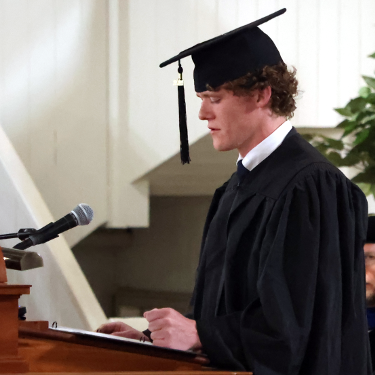 I would like to begin today by giving a much-due thank you and welcome on behalf of the entire Class of 2026 to President O’Reilly, Dr. Cain, Fr. Andrew, Dr. Ashenden, the Board of Governors, parents and benefactors, and the faculty and staff of Thomas Aquinas College. With your prayer and direction — and, when needed, correction — my fellow classmates and I find ourselves, donned with cap and gown on this blissful morning of May, on the cusp of completing the single most important journey of our lives so far.
Our gratitude toward you all can never be fully expressed, but please know of our prayers for each one of you and the mission and future of Thomas Aquinas College. The reality of it is, the goods we have received here are priceless and, as such, your giving of such gifts is unrepayable — we will forever be in your debt.
Now, if you will excuse my curtness, I would like to address my class.
“Have we arrived at such a love for the pursuit and attainment of wisdom that we care not for the judgement and ridicule of the world?”
My beloved classmates, today is like no other day, and we should feel and act as such. Today, our hearts should be filled with pride, for what we have accomplished is no small task, we have “run the race marked out for us,” as the writer of Hebrews describes. There is a certain madness to what we have done. We are mad.
I know this might come across as a great irony in discussing a curriculum which is directed toward the formation of the mind, but what we have done here is madness. And yet, it is a madness that is not opposed to formation of the mind, but rather a madness that comes from such a formation.
This mad man is described by Socrates in Phaedrus, where he states: “He stands outside human concerns and draws close to the divine; ordinary people think he is disturbed and rebuke him for this, unaware that he is possessed by god.” Here, Socrates speaks of the fourth kind of madness, which is “madness” insofar as the man who possesses it has become so much in love with the pursuit of wisdom that those who seek not the same thing do not understand him.
Are we there yet? Have we arrived at such a love for the pursuit and attainment of wisdom that we care not for the judgement and ridicule of the world? This level of surrender does not come about just in four years, but what we have done here has started us along the way. Now we need only to continue.
The true test comes whenever we leave those doors today. It is one thing to show up to class each day, surrounded by (at least for the most part) like-minded people, but it is another thing to go out into the world and share that which we have received here with courage and fortitude. We have found ourselves in a world where men can be married to men, women to women, and, even further, a man can now be a woman, and a woman a man. Can you think of a more striking opposition to truth than this? Are we not faced with the most offensive attack against truth than that which attacks the most fundamental unit of society, the family?
So, if the mission, and I mean the mission, of each one of us is “to bring the light of Christ to all men,” how ought we to do this? If we are mad, who will listen to us? Who will heed our call? Who will attend to what we say?
Well, my beloved classmates, let me tell you. The world is begging for the kind of mad men we aim to be! What do I mean by this? What I mean is that if we take a look at the world around us today, we still see, despite all the “madness” in a pejorative sense of the word, a world which thirsts for truth. We have all grown up in the era of the iPhone, and we have all, except perhaps the rare fortunate few among us, lived through the endless death of “doom scrolling.” What else is doom scrolling but an infinite regress, which we have learned is that which is most opposed to reason?
Fortunately, the world lives outside the iPhone, those small boxes we hold in our hands without end. It is a world which still seeks a “that for the sake of which,” a term which we have become very familiar with over our time here at Thomas Aquinas College. This, I believe, is the most invaluable lesson we learned: to do something “for the sake of itself,” to do something because it in and of itself is good.
“The world is begging for the kind of mad men we aim to be!”
For, as Dr. Ashenden would appreciate as an ex-Anglican, St. John Henry Newman says, “Knowledge is capable of being its own end, such is the constitution of the human mind, that any kind of knowledge, if it really be such, is its own reward.” This desire for the good, the true, and the beautiful, for the sake of the true, the good, and the beautiful, is worth pursuing for itself.
The fact that this trinity of transcendence is worth pursuing for the sake of itself alone provides us with a most invaluable and stable foundation for our lives. For, no matter where we end up or what we do throughout our lives, we have been given access to a source of joy that knows no bounds or obstacles, despite the fact that, as St. Paul says, “For now we see through a glass, darkly, but then face to face: Now I know in part; but then shall I know even as also I am known." Further, whether we realize it or not, this has prepared us to become “disciples of all nations” — if only we heed the call!
So, how is it that we have been prepared throughout these four years to become just that? It is because of this very madness which Socrates spoke of, which I hope and pray never departs from each one of us.
This madness, which arises from the eros of seeking out the divine, was Socrates’ identification of a truth central to our mission as adopted sons and daughters of the Father. It is that fundamental virtue of faith, infused within each one of our souls at baptism, that even a pagan such as Socrates saw as necessary to reaching the divine — a virtue which, although to the world appears irrational, is in fact supra-rational.
The truth of it is that, not only will our faith appear as madness to the world, but it must! Let us embrace this! The words of Christ to His apostles come to mind, when He told them, “If you had been of the world, the world would love its own: but because you are not of the world, but I have chosen you out of the world, therefore the world hateth you.” Is not our Lord and Savior here pointing to that same madness which Socrates himself caught just a glimpse of?
However, a great question arises in my mind when considering this madness and our relationship to the world. It is a simple question, but one that undoubtedly we have all begun to consider quite seriously as our time here has comes to a close, and we are induced into a new beginning: What do we do? What do we do with this kind of madness we have been called to embrace? How do we avoid becoming the “third servant,” who, out of fear of losing his talent, buried it away and hid it from the world?
“No matter where we end up or what we do throughout our lives, we have been given access to a source of joy that knows no bounds or obstacles.”
My mind wanders to one of the greatest saints of our time, who, 44 years ago on this same occasion, gave a Commencement Address to the graduating Class of 1982 on the grounds of our sister campus out west. I am speaking of course of St. Mother Teresa, who addressed this same fear and question weighing on our hearts, and instructed those 22 graduates, saying: “This, the joy of the presence of Jesus, you must be able to give wherever you go. But you cannot give what you don’t have. That’s why you need a pure heart, a pure heart that you will receive as a fruit of your prayer, as a fruit of your oneness with Christ.”
This is my hope for us, my beloved classmates, that we proceed with a pure heart, a heart filled first and foremost with charity and humility, out of which comes this madness for seeking out communion with Christ. If we can remember this, we won’t even be able to help ourselves in sharing that Wisdom we have been given a glimpse of over our four years here, and those we interact with will know that our vigor, our eros, for the pursuit of Wisdom, comes not from a place of pride, but from a place of love, love not only for Wisdom, but for our fellow man, and a love so great that we cannot help but share the good news.
In conclusion of my thoughts on our time here, I would like to end today with some good ol’ verse from a good ol’ Anglican:
Batter my heart, three-person'd God, for you
As yet but knock, breathe, shine, and seek to mend;
That I may rise and stand, o'erthrow me, and bend
Your force to break, blow, burn, and make me new.
I, like an usurp'd town to another due,
Labor to admit you, but oh, to no end;
Reason, your viceroy in me, me should defend,
But is captiv'd, and proves weak or untrue.
Yet dearly I love you, and would be lov'd fain,
But am betroth'd unto your enemy;
Divorce me, untie or break that knot again,
Take me to you, imprison me, for I,
Except you enthrall me, never shall be free,
Nor ever chaste, except you ravish me.
St. John Henry Newman, Pray for us!
| Receive lectures and talks via podcast! | ||||
|---|---|---|---|---|
 |
 |
 |
 |
 |