-
About
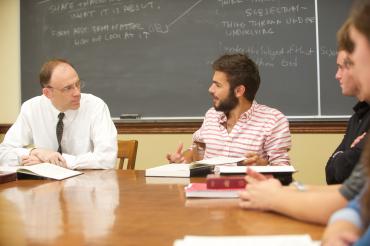 Fidelity & Excellence
Thomas Aquinas College is unique among American colleges and universities, offering a faithfully Catholic education comprised entirely of the Great Books and classroom discussions.
-
A Liberating Education
 Truth Matters
Truth, and nothing less, sets men free; and because truth is both natural and supernatural, the College’s curriculum aims at both natural and divine wisdom.
-
A Catholic Life
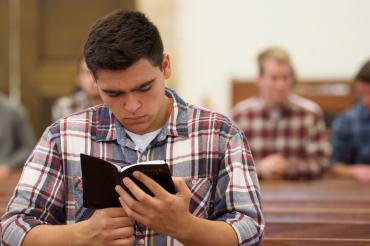 Under the Light of Faith
The intellectual tradition and moral teachings of the Catholic Church infuse the whole life of Thomas Aquinas College, illuminating the curriculum and the community alike.
-
Admission & Aid
 Is TAC Right for You?
Do you enjoy grappling with complex questions? Are you willing to engage in discussions about difficult concepts, with the truth as your ultimate goal?
-
Students & Parents
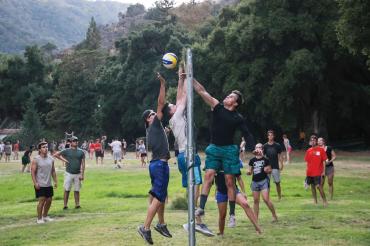 Mind, Body & Spirit
There is always something to do at TAC — something worthwhile, something fulfilling, and something geared toward ever-greater spiritual and intellectual growth.
-
Alumni & Careers
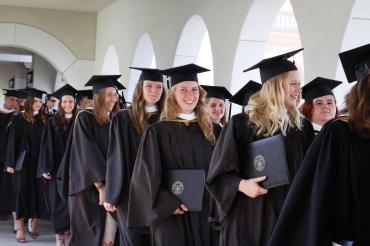 What Can You Do with a Liberal Education?
Nothing speaks more to the versatility of the College’s academic program than the good that our alumni are doing throughout the Church and the world.


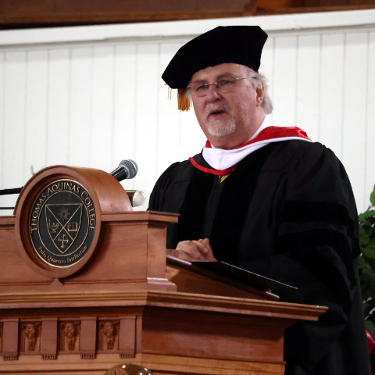
Dr. Gavin Ashenden’s Address to the Class of 2026
Smugglers
by Gavin Ashenden, Ph.D.
Former Chaplain to Queen Elizabeth II
Commencement 2026
Thomas Aquinas College, New England
 President, faculty, parents, family, friends — and most of all, you, the graduating class of Thomas Aquinas College: Thank you for the honor of standing before you today.
I want to begin by saying something simple and true. You have been given one of the rarest gifts available to a young person in the modern world. You have been formed in the mind of the Church. You have spent these years walking in the company of Augustine and Aquinas, of Aristotle and Dante, of the prophets and the apostles and the saints. You have been taught that truth is real, that it is knowable, and that it is worth loving. And you have been taught that the human person is not a random arrangement of atoms, but a creature made in the image and likeness of God.
That is no small thing. In fact, it is almost everything.
I want to tell you a story this afternoon. It is a story from my own early twenties, and it is the reason I asked to speak to you about a particular word. The word is smuggler.
“You have been formed in the mind of the Church. You have spent these years walking in the company of Augustine and Aquinas, of Aristotle and Dante, of the prophets and the apostles and the saints.”
When I was about your age — perhaps a little older — I became a smuggler. Not of contraband as the world understands it, not of anything the customs officers would have recognized as valuable. I smuggled books. I smuggled Bibles into Soviet Russia. And I smuggled the works of Thomas Aquinas into Czechoslovakia, where they were received by underground priests training in what was called the catacomb seminary — men who studied theology in basements and forests because the state had outlawed the formation of priests.
I want you to picture that for a moment. Imagine a young seminarian in Prague in those years. There are no public seminaries. The books are locked away in libraries. There are no Catholic books publicly available. Who has private copies of the Summa Theologiae? If you somehow got hold of Aquinas and were caught with such a book, you risked your career, your freedom, sometimes your life. As we were prepared for the surreptitious visits, we were warned that three out of every five people in any public space could be assumed to be on the government payroll for spying on their neighbors. Those with a vocation to the priesthood ached to be formed in the mind of the Church. They longed for what you have been given freely, openly, in sunlight, for the last four years. Aquinas was the sine qua non of the formation of priests.
So, we smuggled Aquinas to them. We hid the volumes in the linings of suitcases, in the panels of cars, in shipments of innocuous-looking goods. We did this because we believed — we knew — that what was inside those books was more powerful than the regime that was trying to keep it out. We knew that a single copy of the Summa in the right hands could outlast an empire.
And we were right. The empire fell. The Wall came down. The catacomb priests emerged into the daylight. And the books we smuggled in are now read openly in the universities of Prague and Krakow and Budapest.
Now, in those years, the situation seemed clear. There was a wall — a literal wall — between two ways of understanding the human person. On one side was the secular, materialist, atheist regime, which treated man as a unit of production and the soul as a superstition. On the other side was Christendom — wounded, divided, imperfect, but still standing — which insisted that man was made for God, and that his dignity could not be taken from him by any state.
It was a binary opposition. East and West. The lie and the truth. The cage and the open sky.
“The secular mindset that once required tanks and prison camps to enforce itself has discovered that it does not need them.”
And then the Wall came down, and we thought we had won.
I want to tell you something now that I would not have believed when I was your age. The mindset that built that Wall did not die when the Wall fell. It did not stay in Moscow or in Prague. Whatever it was, ideology, meme, or perverted spirit, “it” came west. It crossed the Atlantic. It put on better clothes and learned to speak and then pervert our language. The long march through the institutions began, and today it sits in many — most almost all — of the commanding heights of our own culture.
The secular mindset that once required tanks and prison camps to enforce itself has discovered that it does not need them. It has discovered softer instruments — the algorithm, the curriculum, the corporate human-resources department, the cultural consensus enforced by cancelation and shame. And it is, in its own quiet way, increasingly authoritarian. It tells you which words you may use. It tells you which questions you may ask. It tells you what a human being is — and increasingly, it tells you that a human being is whatever the prevailing opinion says he is this year.
You know this already. I have a sense that God has allowed us to be born at this time of crisis because he has deemed us worthy of the honor of a profound fight against perversity and evil, in the form of a false anthropology and a ruthless secular utopianism.
The world you are walking into is not the world your grandparents walked into. The presumption of Christianity in the public square is gone. The cultural water in which you will swim is, in many places, hostile to the very things you have been taught here to love.
Which brings me back to my word. Smuggler.
The Wall has not disappeared. It has only moved. But it now runs through the heart of our own civilization, and in many cases through our own institutions, and sometimes through our own families. And on one side of that wall there are still seminarians in basements — metaphorically speaking — men and women who hunger for what you have been given. They are in the dorm rooms of secular universities. They are in the offices where no one prays. They are in the hospitals and the law firms and the studios and the start-ups. They are everywhere. They are in virtual catacombs. And they do not know yet that they are hungry. But they are.
You are now the smugglers.
You are the ones who carry, in the linings of your minds and the panels of your souls, something the prevailing culture cannot manufacture and cannot replace. You carry the conviction that the human person is sacred, because God has made us in His likeness and His image. You carry the knowledge that reason and faith are friends, not enemies. You carry the memory of the saints and the habit of prayer and the discipline of the intellect. You carry Christ.
And you will smuggle these things into every room you enter — not by shouting, not by hectoring, not by pretending the world is friendlier than it is, but by being what you are. By doing your work well. By telling the truth. By refusing to participate in the small lies that everyone else has agreed to tell. By loving the people in front of you. By keeping the Faith when keeping the Faith is unfashionable, which it now is, and which it will increasingly be.
Now, I need to say one more thing to you, and it may be the most important thing I will say today. I want to help you confront the siren of despair.
There will be setbacks. There will be days — there will be years — when it looks as though the smugglers are losing. There will be moments when an evil seems too large, a defeat seems too final, a darkness seems too deep. You will lose battles. You will lose people you love. You will see causes you believed in collapse. You will sometimes feel that you have failed.
In those moments, I want you to remember a single sentence from St. Paul, written from a Roman prison to a small, persecuted, and largely hopeless community of Christians in the capital of an empire that would eventually try to kill them all. Paul wrote: We know that in all things God works for the good of those who love him.
In all things. Not in some things. Not in the things we can understand. In all things.
“You are the ones who carry, in the linings of your minds and the panels of your souls, something the prevailing culture cannot manufacture and cannot replace.”
This is among the hardest sentences in Scripture to believe. Because it asks us to believe that God is at work not only in our victories but in our defeats. Not only in our joys but in our sorrows. Not only when our plans succeed but precisely when our plans fail. It asks us to believe that the Cross — the most absolute defeat in human history — was, in the hands of God, the doorway to the Resurrection.
And if that is true of the Cross, then it is true of every smaller cross you will be asked to carry.
Listen to the echo of the Holy Spirit, so clear in St. Paul, sounding down through the centuries — every voice belonging to a man or woman who loved Jesus, who trusted Him, and who bore witness to what they had discovered.
Hear Saint Augustine, in the ruins of a collapsing empire, writing that God judged it better to bring good out of evil than to suffer no evil to exist.
Hear Julian of Norwich, an English anchoress in a century of plague and war, given a vision of Christ in her small cell, and writing down the words He spoke to her: All shall be well, and all shall be well, and all manner of thing shall be well.
Hear Dante, exiled from his city, climbing in his imagination through Hell and purgatory and, at last, into paradise, where the soul of Piccarda tells him the secret of every saint: In His will is our peace.
Hear St. John of the Cross, locked in a monastery prison by his own brothers, writing poems in the dark, and leaving us this: In the evening of life, we will be judged on love alone.
Hear Dostoevsky, who stood once before a Tsarist firing squad and was reprieved at the last moment, and who put into the mouth of his holy monk Fr. Zosima the conviction of his life: Love a man even in his sin, for that is the likeness of Divine Love, and is the highest love on earth.
One Spirit. One Gospel. One promise, repeated and repeated across 2,000 years by people who had every earthly reason to despair and who refused. The plague did not silence them. The exile did not silence them. The prison did not silence them. The firing squad did not silence them.
They are the smugglers who came before you. And they are telling you, today, in this room: Do not despair. The good will triumph. The darkness has not won. The darkness has never won. The tomb is empty. The Wall came down. The catacomb priests are bishops now. And the books we smuggled are in the universities.
So I ask you, on this day of celebration, to make a promise. Promise me — promise yourselves, promise God — that you will struggle never to despair. That you will never be seduced by the lie that evil has the greater power; that you will never believe the threat that the darkness has won.
God brings good out of every setback for those who keep faith with Him. Hold to that. When you cannot see the good, hold to it anyway. That is what faith is.
Graduates, you leave this place today carrying something precious, something dangerous, something the world needs more than it knows. You leave having been formed in hope, in love on faith and as heirs of Aquinas, as friends of the saints, as servants of Christ.
You leave as smugglers who will bring down the kingdom of darkness, again and again and again.
Go now, and smuggle well.
God bless you. God bless your families. And God bless Thomas Aquinas College.
| Receive lectures and talks via podcast! | ||||
|---|---|---|---|---|
 |
 |
 |
 |
 |