-
About
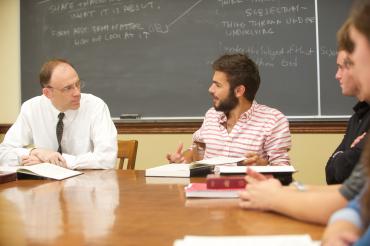 Fidelity & Excellence
Thomas Aquinas College is unique among American colleges and universities, offering a faithfully Catholic education comprised entirely of the Great Books and classroom discussions.
-
A Liberating Education
 Truth Matters
Truth, and nothing less, sets men free; and because truth is both natural and supernatural, the College’s curriculum aims at both natural and divine wisdom.
-
A Catholic Life
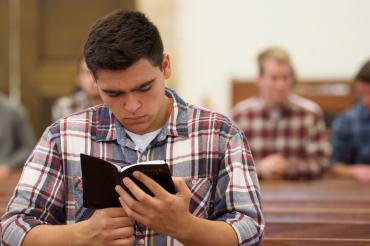 Under the Light of Faith
The intellectual tradition and moral teachings of the Catholic Church infuse the whole life of Thomas Aquinas College, illuminating the curriculum and the community alike.
-
Admission & Aid
 Is TAC Right for You?
Do you enjoy grappling with complex questions? Are you willing to engage in discussions about difficult concepts, with the truth as your ultimate goal?
-
Students & Parents
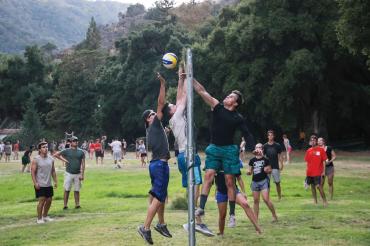 Mind, Body & Spirit
There is always something to do at TAC — something worthwhile, something fulfilling, and something geared toward ever-greater spiritual and intellectual growth.
-
Alumni & Careers
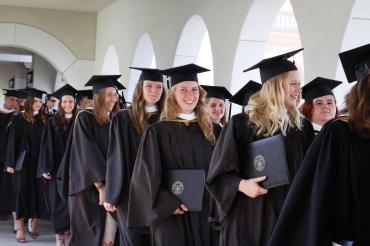 What Can You Do with a Liberal Education?
Nothing speaks more to the versatility of the College’s academic program than the good that our alumni are doing throughout the Church and the world.



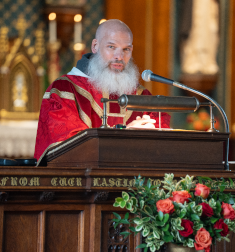
Fr. Andrew Beauregard’s Homily at the Baccalaureate Mass of the Holy Spirit
The Sky Upholds the Earth
by Rev. Andrew M. Beauregard, F.P.C.
Vocations Director, Franciscans of the Poor Christ
Baccalaureate Mass of the Holy Spirit
Commencement 2026
Thomas Aquinas College, New England
In the charming opening scene of the 2002 Italian movie Francesco about the life of St. Francis of Assisi, a little boy is swinging upside down and we (the viewers) see the city of Assisi from his perspective, that is, suspended in mid-air; slowly swinging upside down while the following conversation takes place between the little boy and his companion, a little girl.
 “What do you see, Francis?” she asks.
“Now I know,” he responds.
“What do you know?”
“Promise you won’t tell anyone.”
“Alright, I promise.”
“But tell me, what do you know?” She insists. And in near ecstatic wonder the boy responds: “It is the sky that holds up the earth.”
The sky holds up the earth. One is instantly reminded of a similar scene in G. K. Chesterton’s biography of St. Francis of Assisi, where the city of Assisi totters and sways, hanging on a thread as it were (from Francis’ perspective) the thread of God’s mercy. Assisi in this perilous state is a sign of our world today, for we are all hanging by a thread.
Viewing the world upside down is not a trick, an illusion, or the result of an overly active imagination. It can help us to see things rightly. Our world is both awesome and fragile, majestic, yet teetering. We are continually dependent upon God; upon His love and His mercy. By turning the world upside down, Chesterton reminds us, Francis actually saw it right-side up.[1] It is the sky that holds up the earth.
In this Jubilee Year of St. Francis, we celebrate the 800th year of his death.
Francis was a man of paradox who devoured fastings as a man devours food and plunged after poverty as if digging madly for gold.[2] He spent his whole life proving that he was nothing and that he had nothing. He was a true child of the Holy Spirit, because he was poor. For the Holy Spirit is the “Father of the Poor,” as the Pentecost Sequence reminds us.
“Viewing the world upside down is not a trick, an illusion, or the result of an overly active imagination. It can help us to see things rightly.”
Today’s Commencement Mass is a Mass of the Holy Spirit. I am so happy to celebrate it with all of you, as it is always a great joy to return here to Northfield and Thomas Aquinas College. My special thanks to President O’Reilly and Dean Cain for this gracious invitation, and congratulations to the Class of 2026 and welcome to their families and friends.
The brothers in my Community asked me if I was intimidated or anxious about preaching in a role normally reserved for well known, illustrious men of the Church. But I responded, “Well no, I’m not concerned about that. I’m more intimidated by the fact that I have to give a homily in a Chapel in which the statues of St. Thomas Aquinas and St. John Henry Newman are looking right at me in the sanctuary.”
Today’s Gospel is short, but we need to fill in a few details. The great Feast of which Jesus is speaking is the Feast of Tabernacles. At this Feast, Jesus gives us a simple invitation to come to Him if we are thirsty. Thirst is the only requirement. That means all of us, because “Man is an incarnate thirst,” as Thomas Dubay reminds us. Who among us does not thirst for love, goodness, beauty, truth? Indeed, what does the mind yearn for more ardently than Truth, the Truth Who is Jesus?
We thirst to be heard, understood, affirmed, blessed, safe, touched, chosen, and included. These are basic desires of the human heart.[3] We must look to Jesus as the true living waters that will slake all of our thirsts.
In today’s Gospel, Jesus identifies Himself as the source of the River of Life which flows from the new Temple in Ezekiel 47. There is a spring called the Gihon, which comes from the Temple Mount and flows below the City of David (one of the oldest parts of the City of Jerusalem) to the Pool of Siloam. This provides water to the population of Jerusalem.
“To restore the world, to slake its thirst, we need a restoration of metaphysics, of the permanent things, of the true way of looking at the world: upside down, with the sky upholding it.”
The origins of the name for this river, the Gihon, is interesting. Recall that the Garden of Eden had four rivers. Their names were the Tigris, Euphrates, and the Gihon. It was named such, to illustrate that Jerusalem (where the Temple was located) was the new Garden of Eden. When Jesus extends this metaphor to Himself, He is saying that He is the new Garden of Eden. His Sacred Heart is the new Garden of Eden, where we are called to have our thirst quenched.
One could translate the Greek of John 7:38-39 in such a way that it is clearly Jesus’s heart from which living waters will flow: “Out of His heart shall flow rivers of living water.” This is not an exact quote from the Old Testament, but a paraphrase and summary of at least three passages.
Besides Ezekiel 47, a second is from Numbers 20:10-13, which describes water which flows from the rock in the wilderness. Thirdly, we can see Zechariah 14:8 as a source. Here the Jerusalem of the Last Days is depicted as a spring of living water that flows when the Lord becomes King of all the earth and the nations will come to celebrate the Feast of Booths [Tabernacles] year after year.
These three Scriptures point to Jesus Himself. He is the true Rock in the wilderness of our lives that slakes our thirst. He is the true Temple which gives the water of life to the world. He is the true Lord who reigns as King of all the earth.
Most striking is the water liturgical ceremony which is the backdrop of the last day of the Feast, the day when Our Lord makes His claim. Each morning the Levitical priests drew water with golden vessels from the Pool of Siloam, carried it in procession to the Temple, and poured it out as a libation next to the altar of sacrifice. Likewise, giant candelabras were burned in the sanctuary, which illuminated the Temple Courts while dancers with flaming torches processed through the Temple with songs and music. In this context, Jesus says that Living Waters flow from Him and later (Jn 8:12) that He is the Light of the world.
Graduates, no doubt you have read the works of countless philosophers and theologians in your four years at Thomas Aquinas College, but there is one philosopher whom you haven’t read or even heard of, my friend, Louie. Louie lives in Boston. Well, in the streets of Boston. I met him just a few weeks ago with some young adult Encounter Missionaries who minister to the homeless.
As I was speaking with him, I noticed that he had some letters tattooed on the finger of each hand. I could not make out what they spelled, so I asked, and he showed them to me. They spelled out LOVE and HATE. LOVE and HATE. Taking a lesson from the Socratic Method, I decided not to presume anything. So, I asked him what “love” and “hate” meant.
“It’s God, Father. God.” I looked at him puzzled, so he continued, “You either love Him or you hate Him, but you can’t just like Him. There’s nothing in the middle. Nothing. With God, those are your only options. I tell everyone that.” “
Yeah, I think I know what you mean.”
Instantly, I felt that I was standing in the presence of “The Misfit” (an escaped convict) from Flannery O’Connor’s well known short story, “A Good Man is Hard to Find.” In it, The Misfit clarifies everything with razor-sharp logic. Regarding Our Lord Jesus Christ, he says “If [Jesus] did what He said, then [there’s] nothing for you to do but throw away everything and follow Him, and if He didn’t, then [there’s] nothing for you to do but enjoy the few minutes you got left the best way you can.”
The truth could not be stated so plainly. Either your life is about Jesus Christ and His mission of salvation, or it is about you. There is no third option, nor can there be.
Well, back to my friend, Louie. As I stood before him, I remembered that many Flannery O’Connor short stories, particularly “A Good Man is Hard to Find,” terminated rather violently, usually after an infusion of grace, so I was concerned that I might only have a few minutes left to live.
“At Thomas Aquinas College, you have been taught to situate the many branches of human knowledge in the context of sacred history, thereby relating, as St. Bonaventure taught in the Middle Ages, all truths to the Truth.”
Not wanting death, yet desiring more grace, I pressed the question. “And you, Louie, do you ‘LOVE’ God or do you ‘HATE’ God?”
“I’ve been through a lot, Father, but I love Him and I tell others to love Him too.” How true. Charles de Foucauld famously said, “Once I realized that God was real, it was impossible not to follow Him.” There is no middle ground. The stakes are too high. You cannot be a saint by halves, says Teresa of Avila.
Graduates, either your life is about Jesus Christ and His mission, or it is about you. There is no third option. There is such wisdom here. As we find in our class quote from the Book of Wisdom (7:8) “I preferred her before kingdoms and thrones, and esteemed riches nothing in comparison with her.”
Omne verum a quocumque dicatur a Spiritu Sancto est. All truth, from whomever speaks it, is from the Holy Spirit. Such is the life of Louie. At Thomas Aquinas College, you have been taught to situate the many branches of human knowledge in the context of sacred history, thereby relating, as St. Bonaventure taught in the Middle Ages, all truths to the Truth. To paraphrase St. Bonaventure, “Christ is our metaphysics.”
With all due respect, that is precisely our problem: the breakdown of metaphysics, indeed its very denial. The consequences of which have been thoroughly analyzed by Thomas Joseph White, David Schindler, Charles Taylor, Robert Barron, and many others. Doubtless, you graduates know more than I.
I would like to add that these beginnings have often been traced to my Franciscan confrere William of Ockham, who lived in the 14th century. Lest I, too, be looked upon with some suspicion, let me state that, although I am a Franciscan, I consider myself to be a closet Thomist.
Pierre Manent has argued that, since the 17th century, most of modern philosophy has been a war on scholastic metaphysics.[4] To restore the world, to slake its thirst, we need a restoration of metaphysics, of the permanent things, of the true way of looking at the world: upside down, with the sky upholding it. Ultimately at Thomas Aquinas College, the beauty of the intellect is fostered for its own sake. Indeed, the chosen patron of this year’s graduating class, St. John Henry Newman, would wholeheartedly agree. Properly understood, I think that he would agree with St. Francis, too, that the sky upholds the earth as well.
We all owe God and infinite debt. As Chesterton tells us, “It may seem a paradox to say that a man may be transported with joy to discover that he is in debt … indeed, it is the highest and holiest of the paradoxes that the man who really knows he cannot pay his debt will be forever paying it. He will be forever giving back what he cannot give back, and cannot be expected to give back. He will be [like Francis] always throwing things away into a bottomless pit of unfathomable thanks.” [5] Because it is the sky that holds up the earth.
In this Eucharist, we give thanks to God for the gift of Thomas Aquinas College. Thanks to you, the parents who had the courage to send your children here. Thanks to the faculty and staff who persevere in giving a quiet witness to the truth in class each day. And congratulations to the graduates whom we honor today.
This is your last Mass as students at TAC; a Last Supper, of sorts. The hour has come. It is time. It is a time of sadness and joy, and a time to do battle. You are leaving Rivendell. You are being sent to preach the Truth to a world at war with it, a world that does not recognize the Truth. You may find yourself in Mirkwood, or Minas Tirith, or even the plains of Mordor. But you go with the Holy Spirit, the Spirit of Jesus Christ.
You may save a life, save a planet, or give comfort to or be comforted by a homeless man. You must be like the Apostles, who turned the world upside down (Acts 17:6), so that it can become right-side up But whatever you do, never forget, never stop preaching that Jesus is Lord … because the sky upholds the earth!
[1] G. K. Chesterton, St. Francis of Assisi (1923), 27
[2] G. K. Chesterton, St. Francis of Assisi (1923), 30
[3] Mark Laaser, The Seven Desires of Every Heart (Grand Rapids: Zondervan, 2008)
[4] Mary Harrington, “Thomophobia,” First Things (June/July 2026)
[5] G. K. Chesterton, St. Francis of Assisi (1923), 29.
| Receive lectures and talks via podcast! | ||||
|---|---|---|---|---|
 |
 |
 |
 |
 |