Prospective Tutors
Thomas Aquinas College aims to provide a Catholic liberal education. Our mission statement is A Proposal for the Fulfillment of Catholic Liberal Education, our founding and governing document.


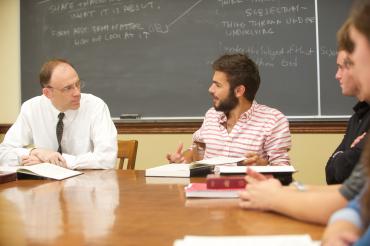
Thomas Aquinas College is unique among American colleges and universities, offering a faithfully Catholic education comprised entirely of the Great Books and classroom discussions.

Truth, and nothing less, sets men free; and because truth is both natural and supernatural, the College’s curriculum aims at both natural and divine wisdom.

The intellectual tradition and moral teachings of the Catholic Church infuse the whole life of Thomas Aquinas College, illuminating the curriculum and the community alike.

Do you enjoy grappling with complex questions? Are you willing to engage in discussions about difficult concepts, with the truth as your ultimate goal?

There is always something to do at TAC — something worthwhile, something fulfilling, and something geared toward ever-greater spiritual and intellectual growth.
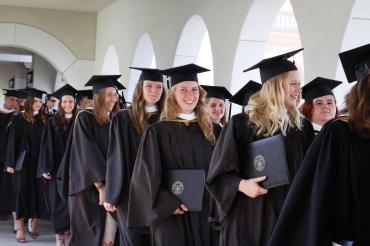
Nothing speaks more to the versatility of the College’s academic program than the good that our alumni are doing throughout the Church and the world.
Thomas Aquinas College aims to provide a Catholic liberal education. Our mission statement is A Proposal for the Fulfillment of Catholic Liberal Education, our founding and governing document.
Reprinted with permission from Cool Colleges: For the Hyper-Intelligent, Self-Directed, Late Blooming, and Just Plain Different. © 2007 by Donald Asher, Ten Speed Press, Berkeley, CA.
A Celebration of Faith and Reason
Cardinal DiNardo Inspires College’s Largest Graduating Class
Faithful Fathers
Cardinal DiNardo and Fr. Buckley Awarded College’s Highest Honor
From the Desk of the President
Dr. McLean’s Remarks to the Class of 2013 at the President’s Dinner
Thomas Aquinas College is devoted to scholarship in the Catholic tradition. The tradition takes its life from the perennial philosophy, sacred theology, and the Magisterium of the Church. Rather than compromise the tradition, Thomas Aquinas College meets the secular challenge to Christian wisdom by offering an education that is carefully grounded in the fundamentals of that wisdom and thorough in the development of its parts.
Men do not create truth; they discover it. Nature loves to hide. She shows herself only to the docile and industrious, and then only when they are responsive to her manner of revelation. The object and the method of education are not arbitrary. For this reason, the curriculum of Thomas Aquinas College is basically the same for all.
In recent times, liberal education has usually been identified with the liberal arts, but traditionally they are distinguished. “Liberal education” names the whole procedure of the philosophic life, including the study of wisdom itself; “liberal arts,” on the other hand, properly names seven introductory disciplines which, though intrinsically of lesser philosophic interest, are “certain ways by which the lively soul enters into the secrets of philosophy” (Hugh of St. Victor).
Liberal education seeks to bring the student to think deeply and carefully about the most important questions which men face. A certain degree of separation from the workaday world is necessary. The student does not remove himself because these questions have nothing to do with the world — it is precisely because they belong inescapably to that workaday world that they are important and must be faced.