-
About
 Fidelity & Excellence
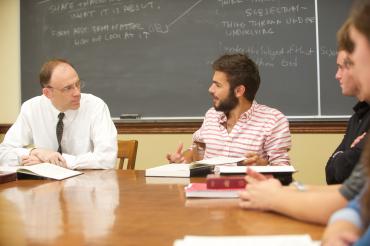
Thomas Aquinas College is unique among American colleges and universities, offering a faithfully Catholic education comprised entirely of the Great Books and classroom discussions.
-
A Liberating Education
 Truth Matters
Truth, and nothing less, sets men free; and because truth is both natural and supernatural, the College’s curriculum aims at both natural and divine wisdom.
-
A Catholic Life
 Under the Light of Faith
The intellectual tradition and moral teachings of the Catholic Church infuse the whole life of Thomas Aquinas College, illuminating the curriculum and the community alike.
-
Admission & Aid
 Is TAC Right for You?
Do you enjoy grappling with complex questions? Are you willing to engage in discussions about difficult concepts, with the truth as your ultimate goal?
-
Students & Parents
 Mind, Body & Spirit
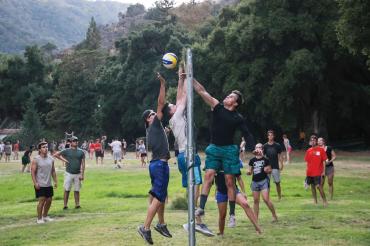
There is always something to do at TAC — something worthwhile, something fulfilling, and something geared toward ever-greater spiritual and intellectual growth.
-
Alumni & Careers
 What Can You Do with a Liberal Education?
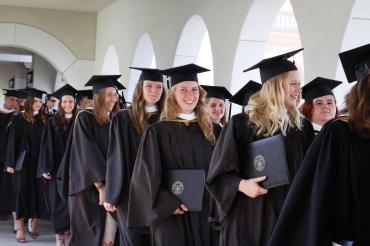
Nothing speaks more to the versatility of the College’s academic program than the good that our alumni are doing throughout the Church and the world.


An Alumna Remembers TAC’s Beloved Founding Librarian
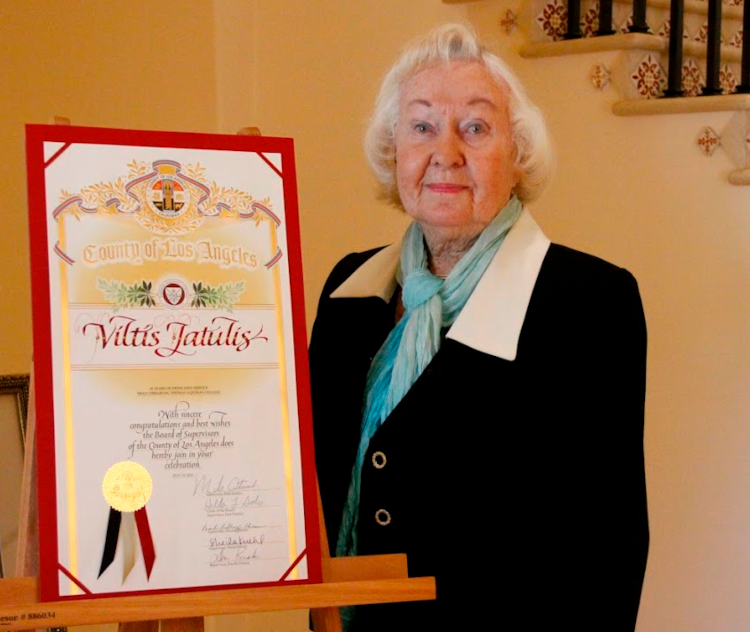
“Viltis Means Hope”
by Rebecca A Likiardopoulos (’10)
One of the first phrases I heard from our beloved College librarian was that her name in English was “Hope.” She lived that thoroughly in her time on this earth, especially at Thomas Aquinas College. Most librarians tend to prize physical books as a repository of knowledge not to be disturbed. She saw them as a connection to our rich Christian heritage and an important guiding light in our studies. She wanted the library to be the shining star on the campus — a place of refuge, reflecting the True, the Good and the Beautiful in every facet.
She would tenderly care for all of the plants throughout the building, believing that the living plants continuously showed the hope in and joy in life to all who came. She truly believed that it is part of our baptismal promise to be the light set upon the hill. Art, music, poetry, literature, and even fashion for her reflected the beauty of the One Who is. She had very distinct separations in her mind regarding items that may be considered in these arenas that were not beautiful. She believed they should be available for reference, but not on display.
“Viltis means Hope.” She remained ever-hopeful throughout her life, despite trials and heavy crosses given to her to bear. She always wanted to spread that hope with the students. She would keep an eye out for foreign students or those from difficult circumstances and would ensure that they would see that the school and life as a whole were reasons for hope. She often did these by giving little gifts of her plant cuttings or fabric for sewing to the girls to brighten their day.
I remember being there the day she opened the report that described everything her father had suffered during World War II — one of the few times I saw tears in her eyes, but she remained so hopeful explaining her vision for her beloved home country of Lithuania and how goodness would continue to prevail. In a world where — even 20 years ago in my time at the school — the world seemed like a dark and depressing place, she shone with always reflecting the Good.
There was never an unsolvable problem for Viltis, she could always manage to raise funds, find sponsors for her ideas, and campaign to get her ideas accomplished. On a smaller scale ,nothing a bit of makeup or “indelible ink” as she referred to her Sharpie markers, couldn’t fix. Were you and a close friend not “close” enough to be engaged for the Senior Reception? She would hand you the top of a soda can tab and wink, telling you now you have a ring — you can both go. There was never any need for despair because, of course, Viltis means Hope.
The daughters of wisdom are Hope, Love and Joy. In practice, Viltis knew this. She loved telling the story of going into labor with her son after a joy-filled polka dance. She would have staff parties with little cakes, drinks, and general merrymaking. You didn’t stop being cared for after you graduated. Many of us have keepsake knitted baby caps she would send or beautiful handwritten notes as we shared with her our life’s milestones.
She saw her work as an extension of her baptismal promise. In that, we remain continuously hopeful in the Resurrection.
Memory Eternal!