-
About
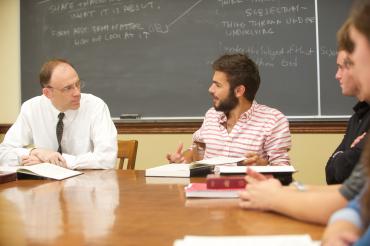 Fidelity & Excellence
Thomas Aquinas College is unique among American colleges and universities, offering a faithfully Catholic education comprised entirely of the Great Books and classroom discussions.
-
A Liberating Education
 Truth Matters
Truth, and nothing less, sets men free; and because truth is both natural and supernatural, the College’s curriculum aims at both natural and divine wisdom.
-
A Catholic Life
 Under the Light of Faith
The intellectual tradition and moral teachings of the Catholic Church infuse the whole life of Thomas Aquinas College, illuminating the curriculum and the community alike.
-
Admission & Aid
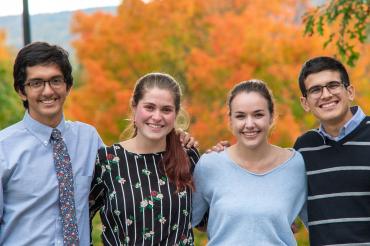 Is TAC Right for You?
Do you enjoy grappling with complex questions? Are you willing to engage in discussions about difficult concepts, with the truth as your ultimate goal?
-
Students & Parents
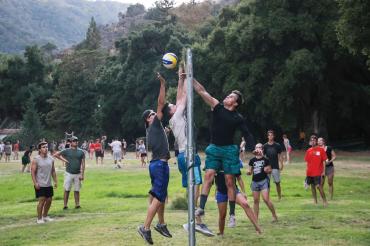 Mind, Body & Spirit
There is always something to do at TAC — something worthwhile, something fulfilling, and something geared toward ever-greater spiritual and intellectual growth.
-
Alumni & Careers
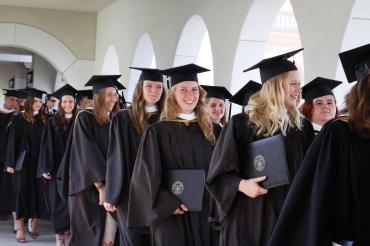 What Can You Do with a Liberal Education?
Nothing speaks more to the versatility of the College’s academic program than the good that our alumni are doing throughout the Church and the world.


Dr. Michael Augros (’92) Speaks at Oxford Union
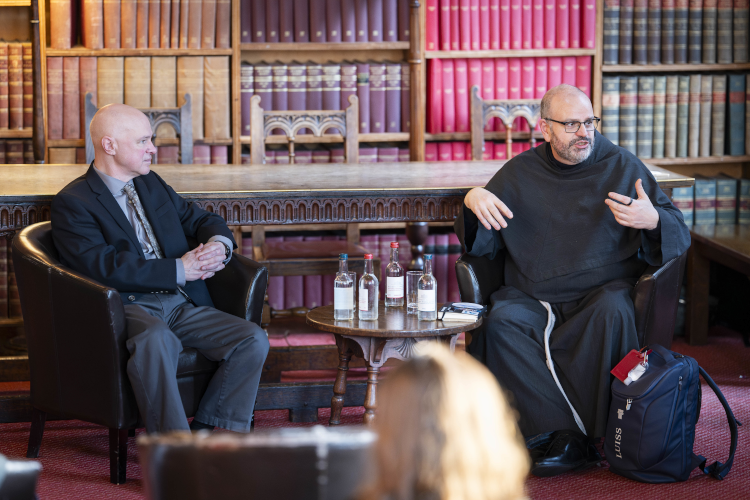
Following the success of Dr. Michael Augros’s (’92) podcast on artificial intelligence, the Oxford Union debate society invited the Thomas Aquinas College, New England, tutor to speak at the end of February.
Known for his extensive studies on Thomistic philosophy, Aristotle’s Metaphysics, and modern science, Dr. Augros is well-regarded by his students — both current and former — for his ability to put forward dense, philosophical concepts in clear and logical terms. One such former student, Joseph Stack (’17), currently enrolled in Oxford’s OX1 Incubator entrepreneurial program, recalled the tutor’s dexterity at laying out arguments and recommended him to the Oxford Union as a good candidate to address its members. “I was asked to speak on what separates the human mind from the material world,” Dr. Augros shares, a topic in which he is well versed, having written multiple books and lectures on the immortality of the soul.
Thus, Dr. Augros found himself walking into the Oxford Union’s famed Old Library on February 25, 2026, for a discussion on “AI, Philosophy, and the Catholic Church.” Joining him for the event was Rev. Paolo Benanti, TOR, a professor at the Pontifical Gregorian University, former advisor to Pope Francis on AI and technology ethics, and member of the United Nations High-Level Advisory Body on AI.
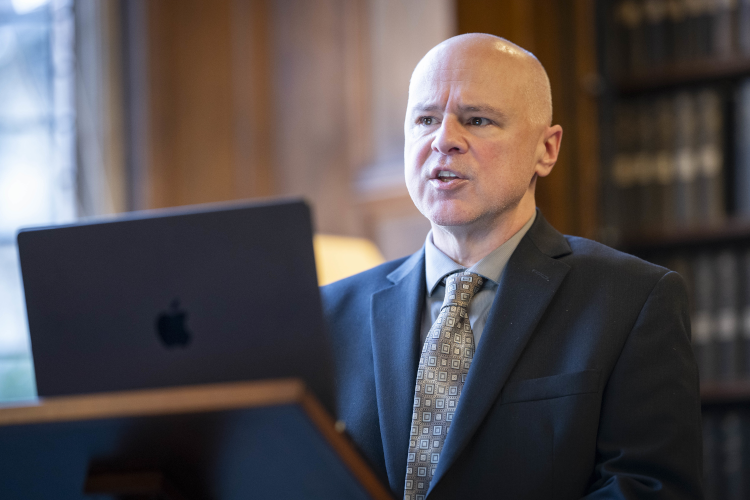
The evening began with a meet-and-greet in Union’s Goodman Library, which then transitioned into a short question-and-answer session with a small group of students. Then, Dr. Augros and Fr. Benanti each gave a 30-minute talk to their audience, about 80 Oxford students and faculty. “Fr. Benanti discussed how AI is changing how countries interact with each other, not always for the better, and how a software-driven society is changing the meaning of ownership and just how much ordinary people can own — in ways that are not always for the better,” explained Dr. Augros. “In my talk, I discussed one argument from St. Thomas for the immateriality of the human mind, based on universals, and answered four objections.”
Throughout the discussions, the audience listened intently and asked insightful questions in a second Q&A at the end of the night. “I really enjoyed my time there,” Dr. Augros comments. “I had a good time interacting with the students, especially a small group I went to dinner with at Christ’s Church that evening.”