-
About
 Fidelity & Excellence
Thomas Aquinas College is unique among American colleges and universities, offering a faithfully Catholic education comprised entirely of the Great Books and classroom discussions.
-
A Liberating Education
 Truth Matters
Truth, and nothing less, sets men free; and because truth is both natural and supernatural, the College’s curriculum aims at both natural and divine wisdom.
-
A Catholic Life
 Under the Light of Faith
The intellectual tradition and moral teachings of the Catholic Church infuse the whole life of Thomas Aquinas College, illuminating the curriculum and the community alike.
-
Admission & Aid
 Is TAC Right for You?
Do you enjoy grappling with complex questions? Are you willing to engage in discussions about difficult concepts, with the truth as your ultimate goal?
-
Students & Parents
 Mind, Body & Spirit
There is always something to do at TAC — something worthwhile, something fulfilling, and something geared toward ever-greater spiritual and intellectual growth.
-
Alumni & Careers
 What Can You Do with a Liberal Education?
Nothing speaks more to the versatility of the College’s academic program than the good that our alumni are doing throughout the Church and the world.



Dr. Thomas West Discusses Foreign Policy in Presidents’ Day Lecture
In honor of Presidents’ Day, Dr. Thomas G. West of Hillsdale College recently visited Thomas Aquinas College, New England, to lecture on “Foreign Policy Principles Underlining the Constitution.”
“Scholars typically neglect the link between foreign policy and the principles in the Declaration of Independence,” began Dr. West, a professor, author, and expert in Aristotelian political philosophy. He explained the commonly held position that, upon America’s rise to become a major power, she aspired to force her version of liberalism on the rest of the world. However, he countered that “the founders’ principles directly oppose today’s American liberal hegemony,” preparing to explore and restate the political theory of the Declaration and its understanding of foreign policy. By this means, he proposed to shed light on the Constitution’s evidence that “its principles of foreign policy are the same as those in the Declaration.”
Dr. West began with the Declaration’s claim that all men are created equal, and specific rights and duties follow from this natural liberty. Liberty is not license, and without some kind of rule or restraint, man’s rights will not be fully secure. “All men have a right to liberty,” he explained, “but no one has the right to take liberty away from another by ruling him without his consent.” Thus, government is a social compact established by and for the citizens for the common good.
There are specific criteria belonging to good government, which Dr. West then proceeded to detail. It must be centered around the people and their consent, then structured to secure their livelihood and property. Turning to the Declaration, it becomes apparent that the government has a duty to protect the property, life, and liberty of the citizen. Foreign policy comes into play under the Declaration by showing the violation of said rights under Great Britain’s rule.
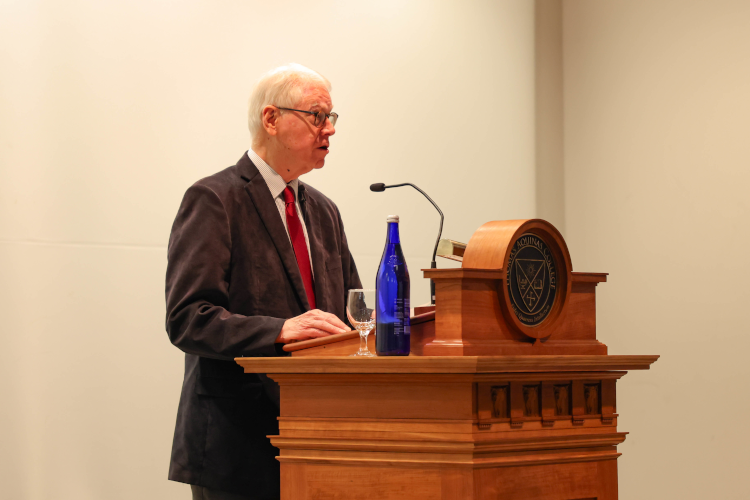
Next, Dr. West explored the significance and validity of wars fought in the nation’s defense, allowed on behalf of the security of peace and justice in the world. However, “the founders of the Constitution did not expect all future wars to be invasions.” The only permitted wars fought through international policy were supposed to be those fought in order to end wars.
He then proposed that national sovereignty must secure independence and freedom of action of the government in order to secure the rights of people through the nation’s policies. “The great rule of conduct for the United States,” he claimed, “is having as much commerce and as little political involvement with other countries as possible. Sovereign freedom of action is a necessity in securing national policies.”
Furthermore, the right to maintain this sovereignty is inseparably accompanied by a duty to recognize all other nations as independent. “Neutrality is generally the best policy with respect to other nations’ international policies,” Dr. West explained, “unless harmed or threatened by that country.” It is the best approach to treat amicably all countries which are not on the offensive, regardless of their policies or systems of government. In this way, he said, “the founders would be called ‘nationalists’ because they prioritize the American nation, in today’s understanding of the word.”
Dr. West closed with the Law of Nations, showing that those alone to whom an injury has been done or intended have the right to go to war. “America has rejected the Law of Nations in the older sense,” he said, “believing now that war anywhere is a threat to America, and our sphere of interest is the entire world.” But foreign policy, he continued, should be for the blessings of liberty, domestic freedom, and happiness. “Politics can’t make men happy in the state-prescribed manner,” he argued. “The idea was to establish the conditions of happiness and wellbeing by means of the protection of individual rights at home and abroad.”
As he concluded his lecture and stepped down from the podium, Dr. West received a sounding ovation from the enrapt audience. The lecture was followed by refreshments in the adjoining room, and a final and fruitful question-and-answer session for all attendees.
| Receive lectures and talks via podcast! | ||||
|---|---|---|---|---|
 |
 |
 |
 |
 |