-
About
 Fidelity & Excellence
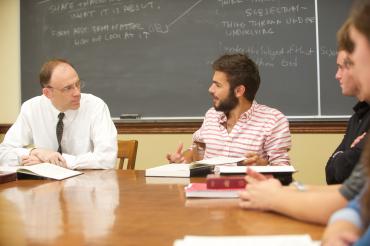
Thomas Aquinas College is unique among American colleges and universities, offering a faithfully Catholic education comprised entirely of the Great Books and classroom discussions.
-
A Liberating Education
 Truth Matters
Truth, and nothing less, sets men free; and because truth is both natural and supernatural, the College’s curriculum aims at both natural and divine wisdom.
-
A Catholic Life
 Under the Light of Faith
The intellectual tradition and moral teachings of the Catholic Church infuse the whole life of Thomas Aquinas College, illuminating the curriculum and the community alike.
-
Admission & Aid
 Is TAC Right for You?
Do you enjoy grappling with complex questions? Are you willing to engage in discussions about difficult concepts, with the truth as your ultimate goal?
-
Students & Parents
 Mind, Body & Spirit
There is always something to do at TAC — something worthwhile, something fulfilling, and something geared toward ever-greater spiritual and intellectual growth.
-
Alumni & Careers
 What Can You Do with a Liberal Education?
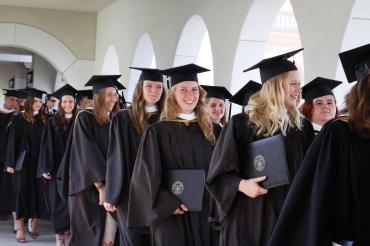
Nothing speaks more to the versatility of the College’s academic program than the good that our alumni are doing throughout the Church and the world.



Dinner and Divine Providence: Dr. Adam Seagrave (’05) Delivers President’s Day Lecture
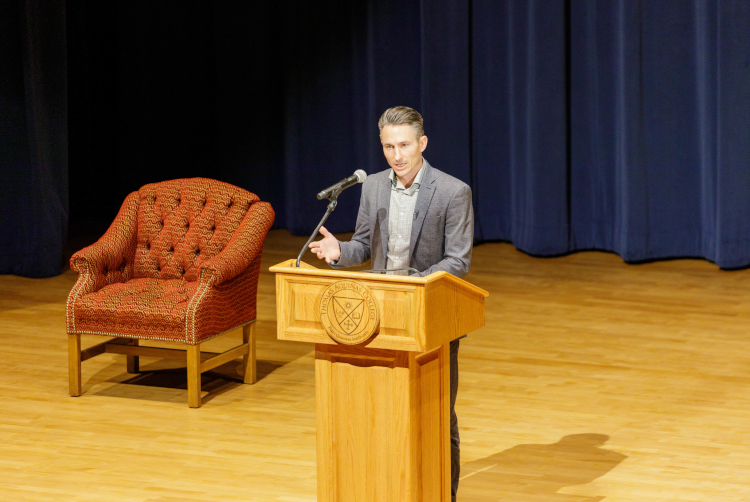
Five days after George Washington’s birthday, students and faculty at Thomas Aquinas College, California, convened after a day of classes for the annual Presidents’ Day dinner and lecture.
At 5 o’clock in the evening, attendees made their way to St. Joseph Commons in their formal attire and visited with friends over a delicious salmon dinner. When dinner concluded, Chaplain Rev. Brendan Kelly read a short prayer written by George Washington for the country, asking that God would “be pleased to dispose us all, to do justice, to love mercy, and to demean ourselves with that charity, humility and pacific temper of mind, which were the characteristics of the Divine Author of our blessed religion; and, without an humble imitation of whose example in these things, we can never hope to be a happy nation.”
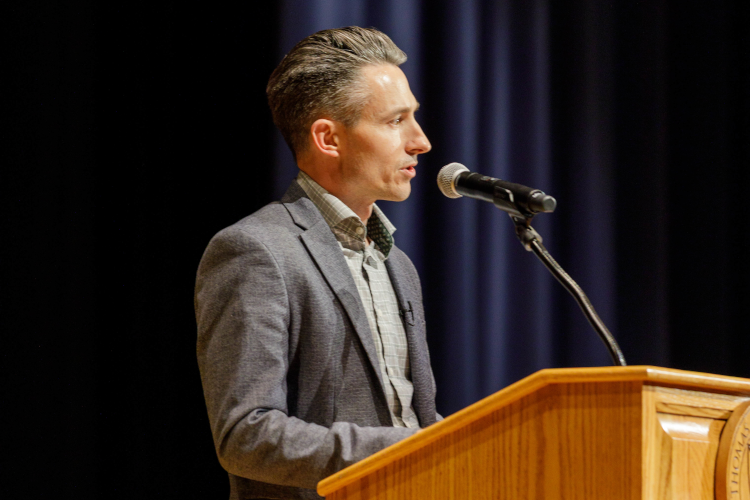
The dinner-goers then moved on to the night’s next event: the President’s Day lecture by Dr. Adam Seagrave (’05). Dr. Seagrave, an associate professor in the School of Civic and Economic Thought and Leadership at Arizona State University, returned to his alma mater to deliver a talk titled God Willing: How the Idea of Divine Providence Shaped the Careers of John Brown, Frederick Douglass, and Abraham Lincoln.
As Dr. Seagrave explained, Divine Providence weighed particularly heavy on the hearts of antebellum Americans, especially these prominent abolitionists. All three men clung to the idea of Divine Providence; “they ‘triverged,’ however, on the next question of how exactly God’s Divine Providence worked,” said Dr. Seagrave, “and subsequently, on how they were respectively called to work with it.”
The question of Divine Providence — whether God controls everything, by whatever means — is one of great difficulty, and one that students at Thomas Aquinas College wrestle with in their sophomore year, reading the works of St. Augustine. Fittingly, Dr. Seagrave discussed Augustine’s accounts of God’s governing, as well as those of St. Thomas Aquinas, before comparing the varying views of Douglass, Brown, and Lincoln and their influence on American history.
Douglass, Dr. Seagrave explained, was an optimist. He held generally that God provides for the whole universe, including man, through His many natural laws; but that He also “has an intelligible and recognizable agenda to deliver the oppressed from injustice,” and would Himself intervene to free the enslaved, as Douglass believed God had done so in his own life.
John Brown, likewise, believed that God had a plan for the world and a plan to free the enslaved; but unlike Douglass, he held that “God issued clear and direct commands to individuals, such as Brown himself, to carry out His providential plan.” A lifelong abolitionist, Brown became a legendary military leader known for his audacity and spirited dedication to the abolitionist cause. According to Dr. Seagrave, Brown discerned his call to intervene by simply considering the Golden Rule: “Do unto others as you would have them do to you.”
Unlike Brown, Lincoln believed that God’s plan for the universe was altogether unknowable and could even differ entirely from human purposes. He additionally maintained that the human tendency to act for one’s own interest is the driving force of nature, thus supporting his view that self-government is “absolutely and eternally right.”
To conclude, Dr. Seagrave explained how the principle of Divine Providence, once so fundamental to our nation, has largely dwindled throughout the United States, along with our sense of purpose, as our country continues to dig itself into an insatiable desire for material goods. Although earlier periods of American history were often characterized by economic struggles, they were also — not coincidentally — times of great devotion to, and contemplation of, the Divine purpose.
“Douglass, Brown, and Lincoln remind us that we should be thinking of ourselves, individually and collectively, on a higher plane, as beings with divinely ordained destinies working together to accomplish purposes bigger than any and all of us,” said Dr. Seagrave. “If they were here with us, they would exhort us to try and be on the right side of providence, with a watchful eye to discerning what the Great Disposer of Events is up to, in our lives and in our moment of human history.”
| Receive lectures and talks via podcast! | ||||
|---|---|---|---|---|
 |
 |
 |
 |
 |