-
About
 Fidelity & Excellence
Thomas Aquinas College is unique among American colleges and universities, offering a faithfully Catholic education comprised entirely of the Great Books and classroom discussions.
-
A Liberating Education
 Truth Matters
Truth, and nothing less, sets men free; and because truth is both natural and supernatural, the College’s curriculum aims at both natural and divine wisdom.
-
A Catholic Life
 Under the Light of Faith
The intellectual tradition and moral teachings of the Catholic Church infuse the whole life of Thomas Aquinas College, illuminating the curriculum and the community alike.
-
Admission & Aid
 Is TAC Right for You?
Do you enjoy grappling with complex questions? Are you willing to engage in discussions about difficult concepts, with the truth as your ultimate goal?
-
Students & Parents
 Mind, Body & Spirit
There is always something to do at TAC — something worthwhile, something fulfilling, and something geared toward ever-greater spiritual and intellectual growth.
-
Alumni & Careers
 What Can You Do with a Liberal Education?
Nothing speaks more to the versatility of the College’s academic program than the good that our alumni are doing throughout the Church and the world.


Dr. Thomas Cavanaugh (’85) Lectures on the Hippocratic Oath
Receive TAC lectures and talks via podcast
In honor of the College’s patron saint and namesake, students and faculty on the California campus celebrated the Feast of St. Thomas Aquinas last week with a festive day featuring a lecture from alumnus scholar Dr. Thomas Cavanaugh (’85).
A professor at the University of San Francisco who specializes in medical ethics, Dr. Cavanaugh is has published two books: Hippocrates’ Oath and Asclepius’ Snake: The Birth of the Medical Profession; and Double-Effect Reasoning: Doing Good and Avoiding Evil. His Wednesday afternoon lecture focused on the concept of double effect — when an action, whose end is good, has a potentially harmful side-effect — and how this concept relates to the Hippocratic Oath required by medical professionals: “to benefit the patient, and to do no harm.”
Dr. Cavanaugh relied heavily on Aquinas’s teachings on morality, beginning first and foremost with the principle of natural law. “St. Thomas says this is the principle we rely on in all of our practical thinking; in all of our doings and our makings, we rely on that first principle: to do good and avoid evil.” He also drew from Thomas’s account of praeter intentionem (“beyond the intention”); nothing prevents an action from having multiple effects, and thus the morality of an action ought be judged not on its side-effects, but on the effect intended.
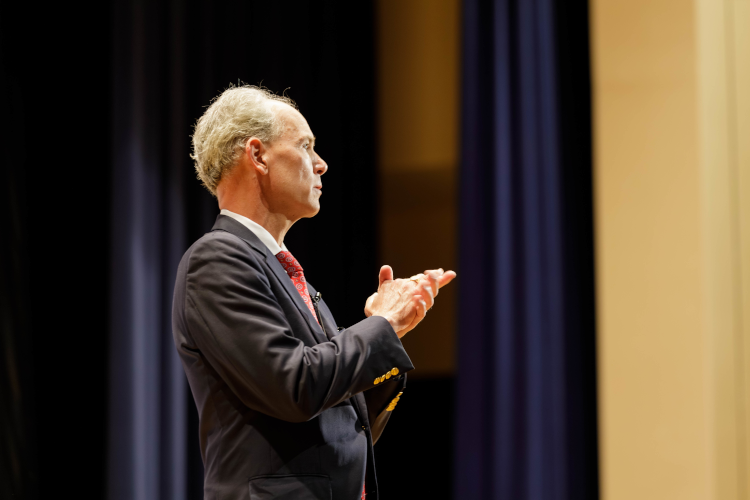
Captivating his audience with real-life medical examples, Dr. Cavanaugh illustrated his first point with aspirin, pointing out its double-effect: it alleviates a fever, but may also cause nausea as a side effect. However, given that the doctor administers aspirin with the intention of helping the fever, the action is morally sound and does not violate the Hippocratic oath or the natural law, even if undesirable effects may result from it.
Leaving aside the more mundane, he shifted the focus to a more complex case study about sedatives, in which the medicine given to a patient to alleviate agonizing pain simultaneously quickened her death. Dr. Cavanaugh walked through the morality of the situation with the audience and explained how, although the situation had grim side effects, the administration of the medicine itself was morally acceptable.
In the last section of his talk, Dr. Cavanaugh discussed the consequentialists, who believe that the morality of an action is determined by its consequences alone, and not by the intention behind the action. Primarily, he discussed the philosophy of Henry Sidgwick, who grounded morality not in intention, but in aiming for the highest possible happiness — prioritizing human pleasure as the end of an action, rather than the glory of God.
In concluding his lecture, Dr. Cavanaugh reflected on two powerful texts. The first was a powerful rebuttal to Sidgwick’s philosophy from T.S. Eliot’s Murder in the Cathedral, spoken by Thomas Beckett: “Now is my way clear. Now is the meaning plain. The last temptation is the greatest treason: to do the right deed for the wrong reason.” The second text came from Wisdom 7:7, which was shared earlier that day at Mass. It reads: “I willed, and understanding was given to me; I prayed, and the spirit of Wisdom came upon me; and I preferred her before kingdoms and thrones.” Dr. Cavanaugh added, “I hope now we see the truth of that claim.”
| Receive lectures and talks via podcast! | ||||
|---|---|---|---|---|
 |
 |
 |
 |
 |