-
About
 Fidelity & Excellence
Thomas Aquinas College is unique among American colleges and universities, offering a faithfully Catholic education comprised entirely of the Great Books and classroom discussions.
-
A Liberating Education
 Truth Matters
Truth, and nothing less, sets men free; and because truth is both natural and supernatural, the College’s curriculum aims at both natural and divine wisdom.
-
A Catholic Life
 Under the Light of Faith
The intellectual tradition and moral teachings of the Catholic Church infuse the whole life of Thomas Aquinas College, illuminating the curriculum and the community alike.
-
Admission & Aid
 Is TAC Right for You?
Do you enjoy grappling with complex questions? Are you willing to engage in discussions about difficult concepts, with the truth as your ultimate goal?
-
Students & Parents
 Mind, Body & Spirit
There is always something to do at TAC — something worthwhile, something fulfilling, and something geared toward ever-greater spiritual and intellectual growth.
-
Alumni & Careers
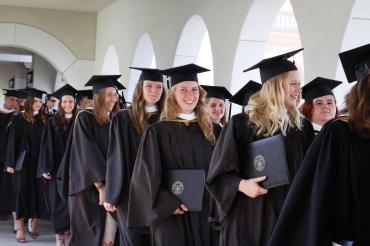 What Can You Do with a Liberal Education?
Nothing speaks more to the versatility of the College’s academic program than the good that our alumni are doing throughout the Church and the world.


Dr. Brett Smith: “Scripture Requires All Christians to be Catholic”
Receive TAC lectures and talks via podcast
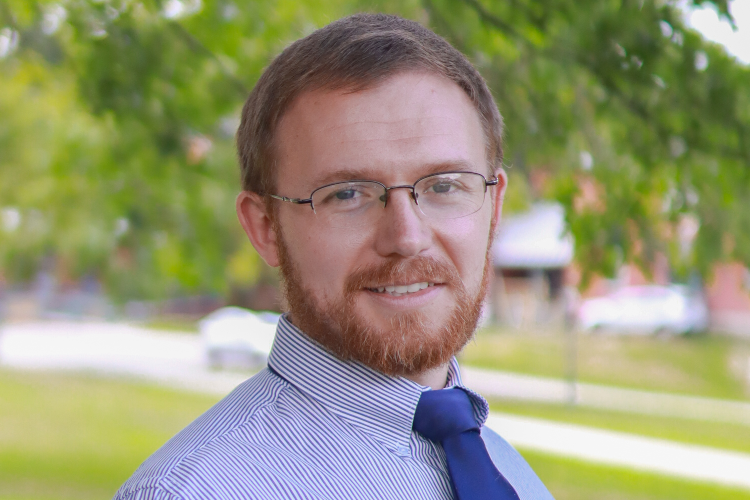
It was a very snowy Wednesday evening, and the students at Thomas Aquinas College, New England, were only too glad to retreat to the snug and warmly lit library to ponder the influence and appeal of Scripture. Accordingly, tutor Dr. Brett Smith prepared and presented an intriguing talk entitled, How Scripture Requires All Christians to be Catholic (PDF).
“My purpose,” he began, “is to distill and present a few of the ways in which Scripture requires all Christians to be Catholic.” Dr. Smith proceeded to lay out his rationalization through four principle arguments: first, the combined necessity of a valid Eucharist with the power of binding and loosing given to the Church in the Gospel of Matthew; second, the power of binding and loosing in reference to instruction; third, the promise of reliable teachers in the Letter to the Ephesians; and fourth, the combination of the significance of transubstantiation and Eucharistic adoration with the New Testament promise of a reliable tradition.
“If transubstantiation is false, then idolatry was central to the worship of every church throughout most of the Christian world.”
Taking these four arguments, Dr. Smith then turned to the doctrine of the Church to show that, in observing the promises made by, the Catholic Church is the only church that fully gives what Scripture has guaranteed. The Church, he declared, is the visible society of those legitimately baptized. Moving into text from 1 Corinthians, chapters 10 and 12, he explained that people are joined to the Body of Christ through baptism, and this body of Christians is indeed visible.
The four essential traits of a society, Dr. Smith posed, are that first, it is composed of a number of people; second, it must pursue a common object; third, it must use a common means; and fourth, it must be under a common authority. Turning again to Scripture and referencing Matthew 16 and 18, he showed that these four essential traits are met by the Catholic Church, as the baptized form a number of people; they commonly pursue salvation; they have the common means of baptism and the Eucharist; and they are united under the authority of the Church. “Truly I say to you, whatever you bind on earth shall be bound in heaven, and whatever you loose on earth shall be loosed in heaven” (Matt. 18:18).
Dr. Smith next proceeded to make his essential arguments for why all Christians should be Catholic. First, the Catholic Church is the only one to have the valid sacrament of the Eucharist, which is necessary for salvation; second, the Church has the power to deny the Eucharist to those who refuse to repent of their sins; and third, this power of excommunication is a means of discipline intended to lead to repentance. Because of the authority granted in Matthew 18, the Church can exercise this discipline.
In true Euclidian-Thomistic manner, Dr. Smith concluded with a syllogistic summary of his arguments. “If transubstantiation is false, then idolatry was central to the worship of every church throughout most of the Christian world. Therefore … transubstantiation is not false. Therefore, transubstantiation is true. If transubstantiation is true, then the Eucharist should be received and worshipped. Therefore, by modus ponens, the Eucharist should be received and worshipped. Only Catholics receive and regularly worship the Eucharist. Therefore, if the Eucharist should be received and worshipped, one should be Catholic.”
| Receive lectures and talks via podcast! | ||||
|---|---|---|---|---|
 |
 |
 |
 |
 |