-
About
 Fidelity & Excellence
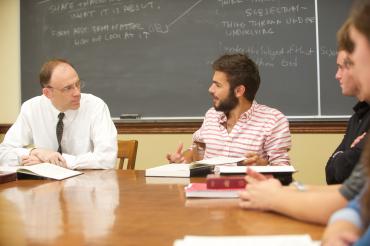
Thomas Aquinas College is unique among American colleges and universities, offering a faithfully Catholic education comprised entirely of the Great Books and classroom discussions.
-
A Liberating Education
 Truth Matters
Truth, and nothing less, sets men free; and because truth is both natural and supernatural, the College’s curriculum aims at both natural and divine wisdom.
-
A Catholic Life
 Under the Light of Faith
The intellectual tradition and moral teachings of the Catholic Church infuse the whole life of Thomas Aquinas College, illuminating the curriculum and the community alike.
-
Admission & Aid
 Is TAC Right for You?
Do you enjoy grappling with complex questions? Are you willing to engage in discussions about difficult concepts, with the truth as your ultimate goal?
-
Students & Parents
 Mind, Body & Spirit
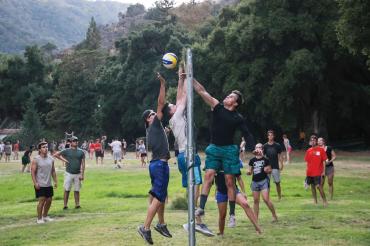
There is always something to do at TAC — something worthwhile, something fulfilling, and something geared toward ever-greater spiritual and intellectual growth.
-
Alumni & Careers
 What Can You Do with a Liberal Education?
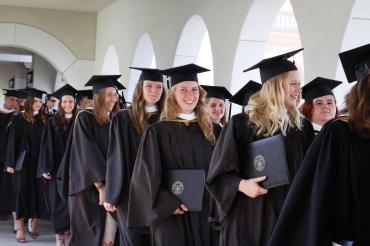
Nothing speaks more to the versatility of the College’s academic program than the good that our alumni are doing throughout the Church and the world.


Dr. Matthew Levering Discusses Eucharistic Typology in the Old Testament
Receive TAC lectures and talks via podcast
On the Feast of St. Thomas Aquinas, Dr. Matthew Levering, a professor at University of St. Mary of the Lake, traveled to the New England campus to present a lecture entitled, “The Eucharist and Typology.”
Dr. Levering introduced his talk in light of St. Thomas Aquinas himself, saying that he intended for his listeners to learn from the greatest teacher and lover of Sacred Scripture. Furthermore, all Christians can follow in Aquinas’s footsteps and come to ponder the mystery of the Eucharist through the connection between the Old and New Testaments, and the truths which they bring to light through their correlation.
Having introduced the talk in relation to Thomas Aquinas, Dr. Levering began his first argument using Aquinas’s points from the Summa Theologica, concerning the role of Old Testament types and figures as grounds for the encounter of Christ in the Eucharist. “They are fueled and fostered by apprehending the Eucharist as the new Passover sacrifice as the new manna for the journey to the new and final Promised Land,” he said. These Old Testament types — realities taken up from the Old Testament and used to illuminate truths in the New — enable believers to more firmly grasp the obscure and incredible.
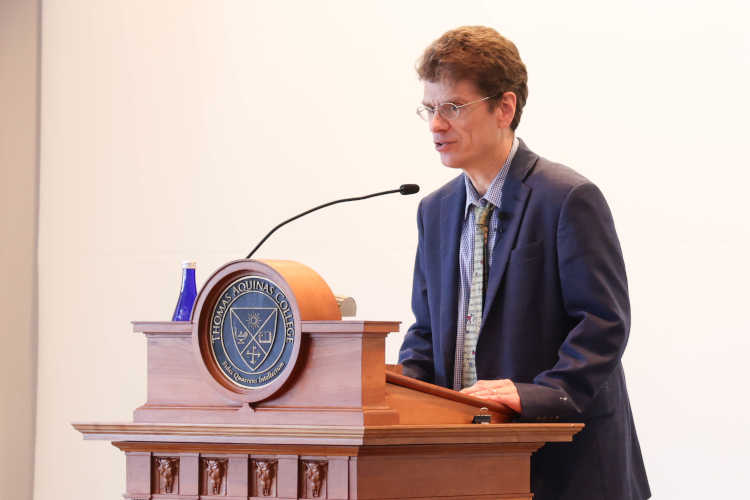
Dr. Levering detailed Aquinas’s position on the type of the Passover Lamb, showing that it is the most pertinent in understanding the Eucharist. He proceeded to explore Aquinas’s objections through different preeminent Old Testament types for the Eucharist, considering priestly sacrifice and Melchizedek the high priest, the Passover Lamb, the Israelites’ crossing of the Red Sea, and the manna that rained from the heavens. “You need all of these types to understand the Eucharist absolutely,” Dr. Levering observed. “But the Passover Lamb is the best type.”
The Eucharist contains Christ crucified in the Passover Lamb and is a sacramental offering of bread and wine akin to the priestly sacrifice of the Old Testament. The Eucharist communicates grace and charity into eternal life, like the baptism of the Israelites in the crossing of the Red Sea, and is a sacramental representation of Christ’s sacrifice on the Cross, opening the gates of Heaven and leading away from sin. “The Passover lamb has something to do with all of these other types,” Dr. Levering explained, “and so its symbolic signification best instructs Christians about the Eucharist.”
The visiting lecturer concluded by entreating his audience to start with the Old Testament when reading the Scriptures and to look for spiritual or doctrinal elucidation. “The New Testament accounts of Jesus’s paschal mystery, and the Eucharist, are deeply embedded in Old Testament types or figures," he said. “So were the Eucharistic theologies of the Church fathers. And so also is Aquinas’s Eucharistic theology; and so must our own Eucharistic theology be today.”
| Receive lectures and talks via podcast! | ||||
|---|---|---|---|---|
 |
 |
 |
 |
 |