-
About
 Fidelity & Excellence
Thomas Aquinas College is unique among American colleges and universities, offering a faithfully Catholic education comprised entirely of the Great Books and classroom discussions.
-
A Liberating Education
 Truth Matters
Truth, and nothing less, sets men free; and because truth is both natural and supernatural, the College’s curriculum aims at both natural and divine wisdom.
-
A Catholic Life
 Under the Light of Faith
The intellectual tradition and moral teachings of the Catholic Church infuse the whole life of Thomas Aquinas College, illuminating the curriculum and the community alike.
-
Admission & Aid
 Is TAC Right for You?
Do you enjoy grappling with complex questions? Are you willing to engage in discussions about difficult concepts, with the truth as your ultimate goal?
-
Students & Parents
 Mind, Body & Spirit
There is always something to do at TAC — something worthwhile, something fulfilling, and something geared toward ever-greater spiritual and intellectual growth.
-
Alumni & Careers
 What Can You Do with a Liberal Education?
Nothing speaks more to the versatility of the College’s academic program than the good that our alumni are doing throughout the Church and the world.



Rev. Patrick Carter, O.S.B. (’05) Lectures on Friendship, Justice, and the “Noble Due”
Receive TAC lectures and talks via podcast!
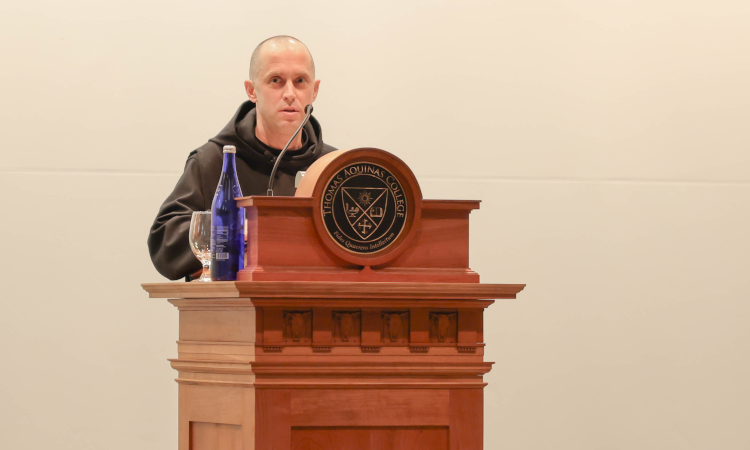
A graduate of the Class of 2005 and now the secretary of the Curia of the Benedictine Confederation in Rome, Rev. Patrick Carter, O.S.B. (’05) made a first visit to his alma mater’s New England campus in November to lecture on the “Noble Due,” as understood by St. Thomas Aquinas and Aristotle.
Fr. Carter began by exploring Aquinas’ Question 80 — “On the Parts of Justice” — from the Secunda Secundae of the Summa Theologiae. As he examined the virtues annexed with justice and whether they are suitably listed, he explained the distinction between the two different dues. “The virtues have to have something in common with the principal virtue,” he argued, “and, in some respect, they must fall short of the perfection of that virtue. Justice is to render what is due to the other. It is a deficiency in the definition of justice, not necessarily an inferiority as regards justice as something more perfect.”
He then explained the distinction between the legal and moral due: the debitum morale is a moral due owed through a certain integrity of virtue, whereas the legal due, or debitum legale, is that which one is bound to render by legal obligation, chiefly concerned with justice.
According to Fr. Carter, St. Thomas employs the idea of different types of due in order to distinguish a set of virtues from the perfect notion of the virtue of justice. He explained further that the debitum morale rises from the integrity or morality of nature and, taking this understanding of these dues, proceeded to distinguish between the types of friendship.
Diving into Aristotle’s Nicomachean Ethics, Fr. Carter then laid out the three types of friendship: those of virtue, of pleasure, and of utility. Applying the moral due to these relationships, he distinguished ethical from legal friendships. Man expects some kind of return for almost everything he does, as is just. Sometimes the motive to give is a result of pure generosity, but at other times it is wrapped up in the expectation of receiving something else in return. “For we wish what is noble,” said Fr. Carter, “but often choose what is personally beneficial.”
If the receiver is able, Fr. Carter proposed, he should always willingly return the equivalent of what he received to the giver, for such is his moral obligation. From this, the lecturer explained the difference between friendships of virtue and friendships of utility. One should act on the demands of justice as regards returns and dues, not simply rely on the presumed willingness of the friend.
For his final point, Fr. Carter claimed that the nature of this moral due is something that makes it noble, and even above the type of due involved in the virtue of justice. “As distinguished from the legal,” said Fr. Carter, “the moral due tends toward friendship both in definition and in fact. Its measure is the noble good, which can be extended to the whole of virtue. The virtues which render this noble due are signs of greater virtue in a more virtuous manner, as they transcend what is merely required by the cardinal virtue of justice and are signs of nobility of character."
Thus, since we can call this response a duty of nobility of character, so it is a noble due. “Seeking to fulfill this noble due in truth, gratitude, and liberality,” Fr. Carter concluded, “makes life better for everyone around us.”
As he stepped away from the podium, the audience applauded Fr. Carter and followed him to the library for an open-table discussion. “I found this lecture to be a riveting dive into the Aristotelian view of friendship and justice,” remarked Margaret Asjes (’29). “It has made me think more about my relationships with others.”
| Receive lectures and talks via podcast! | ||||
|---|---|---|---|---|
 |
 |
 |
 |
 |