-
About
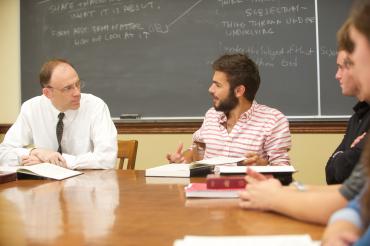 Fidelity & Excellence
Thomas Aquinas College is unique among American colleges and universities, offering a faithfully Catholic education comprised entirely of the Great Books and classroom discussions.
-
A Liberating Education
 Truth Matters
Truth, and nothing less, sets men free; and because truth is both natural and supernatural, the College’s curriculum aims at both natural and divine wisdom.
-
A Catholic Life
 Under the Light of Faith
The intellectual tradition and moral teachings of the Catholic Church infuse the whole life of Thomas Aquinas College, illuminating the curriculum and the community alike.
-
Admission & Aid
 Is TAC Right for You?
Do you enjoy grappling with complex questions? Are you willing to engage in discussions about difficult concepts, with the truth as your ultimate goal?
-
Students & Parents
 Mind, Body & Spirit
There is always something to do at TAC — something worthwhile, something fulfilling, and something geared toward ever-greater spiritual and intellectual growth.
-
Alumni & Careers
 What Can You Do with a Liberal Education?
Nothing speaks more to the versatility of the College’s academic program than the good that our alumni are doing throughout the Church and the world.


ICYMI: TAC’s John Goyette in The Daily Signal: “Let Students Read the Whole Book”
“Let Students Read the Whole Book”
by Dr. John J. Goyette, Thomas Aquinas College
FOR IMMEDIATE RELEASE:
For more information, please contact:
Chris Weinkopf, Executive Director of College Relations
805-421-5926 | pr@thomasaquinas.edu
The first time I ever cracked open a work of William Shakespeare was during my freshman year of high school, when my English teacher assigned “Julius Caesar.” It was awful.
The vocabulary was archaic, the syntax confusing. I couldn’t make sense of Shakespeare’s literary devices, and the relentless political maneuvering was nearly impossible for my 14-year-old mind to track.
But, with the teacher’s help, I fought my way through, page by page, scene by scene, until I not only finished the tragedy, but appreciated it—the powerful rhetoric, the interplay of poetry and prose, the ominous imagery and macabre foreshadowing.
When I was done, I felt as if I’d just scaled Mount Everest, and a lifelong love of literature and learning was born.
Had my teacher assigned only an excerpt from “Julius Caesar”—or a shorter work, such as a sonnet—I wouldn’t have experienced that sense of accomplishment or intellectual growth. I would have suffered the same, initial frustration without attaining that ultimate joy.
Unfortunately, frustration without joy is the norm at most high schools these days, where dispirited teachers coddle students rather than educate them.
A New York Times survey of 2,000 educators, students, and parents finds that most high schoolers read very few, if any, full-length books anymore. Citing a lack of time, short attention spans, and a compulsion to teach to standardized tests, respondents reported that most students were lucky to read one or two books, per year, from beginning to end.
Read the whole thing in The Daily Signal
MORE NEWS FROM THE COLLEGE
- TAC-New England Hosts 2025 Alumni & Parent Day
- Without Trying, TAC Ranks #1 on U.S. News Social Mobility Index
- Dr. Tomás Bogardus Refutes Gender Ideology
# # #
About Thomas Aquinas College
With campuses in California and Massachusetts, Thomas Aquinas College has developed over the last half century a solid reputation for academic excellence in the United States and abroad. It is highly ranked by secular organizations, such as The Princeton Review and U. S. News, as well as Catholic guides, including the Cardinal Newman Society and the National Catholic Register. The college offers one, four-year, classical curriculum that spans the major arts and sciences. Instead of reading textbooks, students study the original works of the greatest thinkers in Western civilization — the Great Books — in all the major disciplines. Rather than listen to lectures, they work through these texts in small, rigorous classroom discussions. The academic life of the college is conducted under the light of the Catholic faith and flourishes within a close-knit community, supported by a vibrant spiritual life. Alumni consistently excel in the many world-class institutions at which they pursue graduate degrees in fields such as law, medicine, business, theology, and education.